How to Reinforce Cat Behavior the Right Way
Why Reinforcing Cat Behavior Isn’t Just About Treats—It’s About Trust, Timing, and Tiny Moments
If you’ve ever wondered how to reinforce cat behavior without resorting to yelling, spraying water, or giving up entirely—you’re not alone. In fact, over 68% of cat owners misapply reinforcement techniques daily, accidentally strengthening unwanted behaviors like scratching furniture or demanding attention at 4 a.m. (2023 International Society of Feline Medicine survey). Unlike dogs, cats learn through highly specific cause-effect associations—and they’re far more sensitive to timing, consistency, and emotional context than most caregivers realize. Getting this right doesn’t just reduce stress for your cat—it deepens your bond, prevents behavioral euthanasia (still the #1 cause of death for healthy cats under age 5), and transforms cohabitation from reactive management into joyful partnership.
The Reinforcement Mindset Shift: From Correction to Connection
Before diving into mechanics, let’s reset the foundation. Reinforcement isn’t about ‘training’ cats to obey—it’s about shaping their environment and responses so desirable behaviors become the easiest, most rewarding choice. As Dr. Sarah Heath, a European Veterinary Specialist in Behavioural Medicine, explains: ‘Cats don’t misbehave—they communicate unmet needs. Our job is to listen, then reinforce the version of that communication we can live with.’
Start by observing—not judging. Keep a 3-day ‘Behavior Log’ noting: time of day, antecedent (what happened just before), behavior, and consequence (what you or the environment did afterward). You’ll likely spot patterns: e.g., your cat scratches the couch *only* after waking from a nap near the window (antecedent: post-nap energy + visual stimulation), and you respond by shooing them away (consequence: attention + movement = accidental reinforcement).
True reinforcement hinges on three non-negotiable pillars:
- Contiguity: The reward must follow the behavior within 1–2 seconds—or the cat won’t link cause and effect.
- Consistency: Every instance of the target behavior must be reinforced *at first*. Later, switch to variable schedules—but never skip early repetitions.
- Individual Value: What motivates one cat (a tuna flake) may bore another (who prefers slow blinks and chin scritches). Test and track preferences weekly.
Step-by-Step: How to Reinforce Cat Behavior Using Positive Reinforcement Only
Positive reinforcement means adding something pleasant *immediately after* a desired behavior to increase its future frequency. It’s the gold standard—and the only method endorsed by the American Veterinary Society of Animal Behavior (AVSAB) for routine behavior support.
Step 1: Define the Target Behavior Precisely
Vague goals fail. Instead of “be less aggressive,” aim for “touch my hand with nose for 2 seconds while seated.” Instead of “stop meowing at night,” target “enter carrier voluntarily when door is open.” Precision lets you recognize and reward the exact moment it happens.
Step 2: Choose Your Reinforcer—Then Validate It
Don’t assume food works. Run a 5-minute preference test: offer 3 options (e.g., freeze-dried chicken, soft cheese, gentle ear rub) for 60 seconds each. Track duration of engagement and pupil dilation (a subtle sign of high motivation). One client’s senior cat ignored treats but purred intensely during 10-second shoulder massages—so that became her primary reinforcer for litter box use.
Step 3: Shape Incrementally—Never Expect Perfection
Use ‘successive approximations’: reward tiny steps toward the goal. To teach ‘come when called,’ first reinforce looking up when you say their name. Next, reward turning head toward you. Then stepping one paw toward you. Each stage gets 5–10 reps per session, max 3 minutes long (cats’ optimal learning window). End every session on success—even if it’s just eye contact.
Step 4: Fade Lures, Then Cues, Then Rewards
Start with luring (holding a treat to guide behavior), then add a verbal cue *as* the behavior occurs (“Yes!”), then phase out the lure while keeping the cue. Finally, shift from continuous (every time) to variable ratio reinforcement (e.g., reward 3 out of 5 successful sits)—which makes behaviors more resistant to extinction.
When Reinforcement Backfires: Fixing the 3 Most Common Mistakes
Mistake #1: Rewarding the Wrong Moment
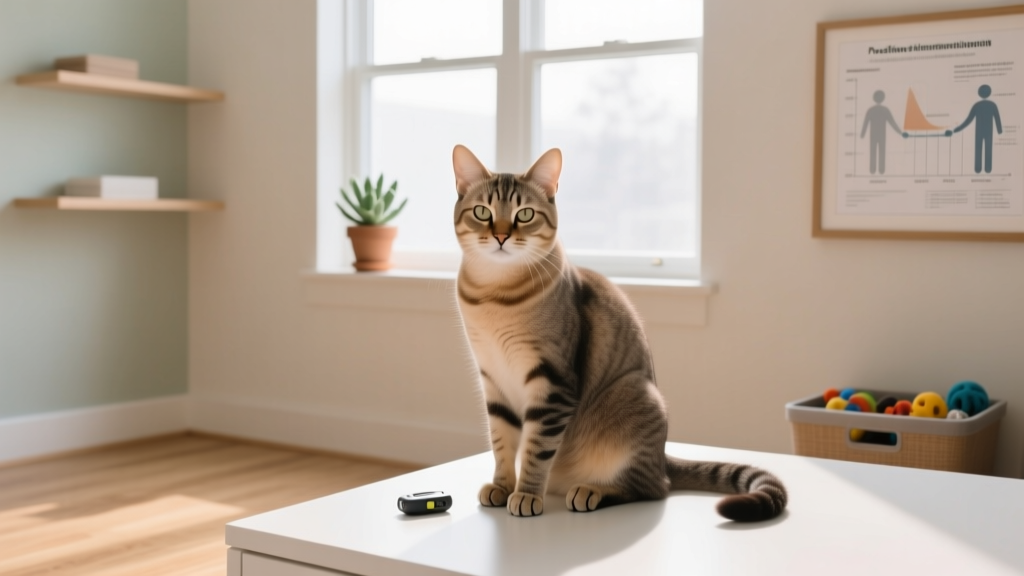
You call your cat, they finally wander over 20 seconds later—and you give a treat. Too late! They associated the reward with walking into the kitchen, not responding to your voice. Fix: Use a clicker or sharp ‘Yes!’ sound *the instant* their ear twitches toward you—or better yet, mark the micro-behavior (e.g., weight shift forward) and reward immediately.
Mistake #2: Inconsistent Consequences
One family member gives attention when the cat jumps on the counter; another shoves them off. The cat learns: ‘Sometimes jumping works—so I’ll keep trying.’ Fix: Agree on ONE response for each behavior—and write it down. Post it on the fridge: ‘Counter-jumping → silent removal + 10-second ignore → redirect to cat tree with toy.’
Mistake #3: Overlooking Environmental Triggers
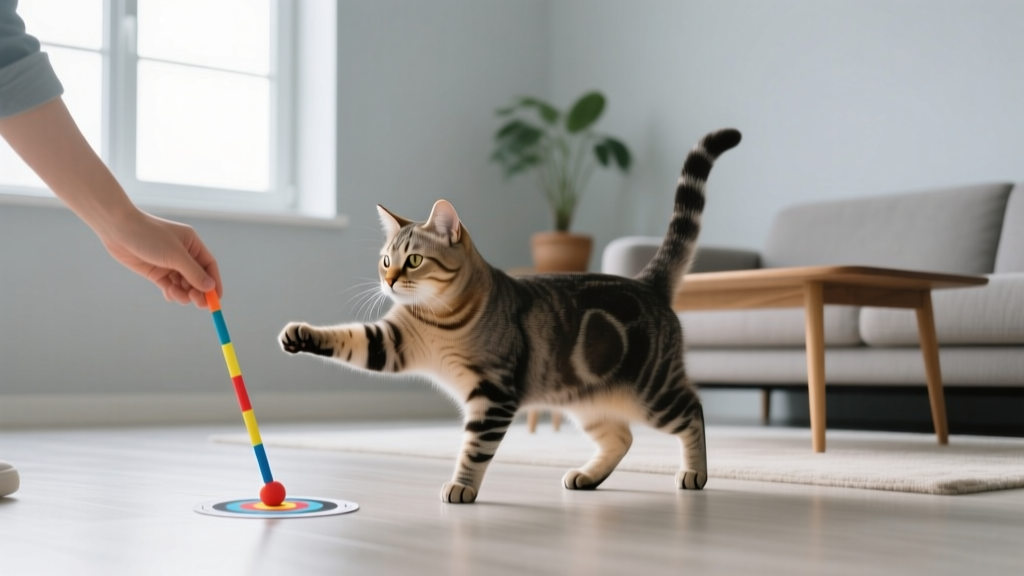
Reinforcing ‘quiet’ at night fails if your cat’s hunting instinct is triggered by birds outside the window at dawn. You’re fighting biology with treats. Fix: Block visual access pre-sunrise, provide 15 minutes of interactive play with a wand toy at dusk (mimicking natural hunt-catch-eat-groom-sleep cycle), *then* reinforce settling on their bed with gentle petting.
Real-world example: Luna, a 3-year-old rescue with fear-based aggression, snapped when approached. Her owner tried treats—but Luna froze and backed away. A certified feline behavior consultant reframed the goal: reinforce ‘choosing proximity.’ They sat 6 feet away, tossed high-value treats *away* from themselves (reducing pressure), and marked with a soft ‘good’ when Luna glanced their way. Within 9 days, Luna voluntarily sat 3 feet away for 12 seconds—earning her first chin scratch. No force. No fear. Just patience and precision.
Reinforcement Timeline & Strategy Table
| Phase | Duration | Primary Action | Tools Needed | Expected Outcome |
|---|---|---|---|---|
| Assessment & Baseline | Days 1–3 | Log antecedents, behaviors, consequences; identify 1 target behavior | Pen & notebook or digital app (e.g., CatLog) | Clear pattern recognition; validated reinforcer identified |
| Shaping Foundation | Days 4–14 | 5x daily, 2-min sessions; reward successive approximations | Clicker or marker word; validated reinforcer; quiet space | Target behavior occurs reliably in low-distraction setting |
| Generalization | Days 15–28 | Add mild distractions (e.g., TV on low); vary location/timing | Same tools + distraction gradient list | Behavior occurs across 3+ environments with 80%+ reliability |
| Maintenance & Fading | Day 29+ | Switch to variable reward schedule; integrate into daily routines | Journal to track reward ratios; environmental enrichment items | Behavior persists with minimal external reinforcement; self-rewarding (e.g., cat uses scratching post then grooms) |
Frequently Asked Questions
Can I use punishment instead of reinforcement to stop bad behavior?
No—and here’s why it’s dangerous. Punishment (yelling, spray bottles, clapping) suppresses behavior temporarily but increases fear, anxiety, and redirected aggression. Worse, cats rarely associate punishment with the act itself—they link it to *you* or the *location*, damaging trust. A landmark 2021 study in Applied Animal Behaviour Science found cats subjected to punishment were 3.2x more likely to develop chronic stress-related illnesses (e.g., idiopathic cystitis) within 6 months. Reinforcement builds safety; punishment builds silence—and silence is often the first sign of surrender, not compliance.
My cat ignores treats—what else can I use as reinforcement?
Many cats are ‘low-food-motivated’—especially seniors, overweight cats, or those with dental pain. Try these evidence-backed alternatives: (1) Play reinforcement: 10 seconds of wand toy chase *immediately after* desired behavior; (2) Social reinforcement: Slow blinks + 3-second chin scratch (validated by feline ethologists as high-value social currency); (3) Access reinforcement: Opening a door to a favorite room or window perch. Always test: present option for 30 seconds—if cat leans in, purrs, or rubs, it’s working. If they walk away, try another.
How long does it take to reinforce a new behavior?
It depends on the behavior’s complexity and your cat’s history—but most simple behaviors (e.g., touching a target stick, entering carrier) show reliable results in 7–14 days with consistent 2-minute daily sessions. Complex behaviors (e.g., accepting nail trims, tolerating brushing) take 3–8 weeks. Key insight from Dr. Mikel Delgado, certified cat behaviorist: ‘Don’t measure progress in days—measure it in successful repetitions. Aim for 50 accurate, well-timed reinforcements—not 50 days.’ Rushing causes frustration; patience with precision yields lifelong results.
Will reinforcing one behavior make my cat ‘demand attention’ all the time?
Only if reinforcement is delivered inconsistently or on a fixed schedule. Cats aren’t ‘manipulative’—they’re excellent operant learners. If you reward jumping on your lap *only when you’re working*, they’ll jump on your laptop. But if you reinforce ‘lying quietly beside you’ with gentle strokes *during relaxed moments*, they’ll choose calm presence. Structure matters: designate ‘reinforcement windows’ (e.g., 7–7:05 p.m. daily) and use environmental cues (e.g., a specific mat) to signal when rewards are available—teaching your cat that good behavior has predictable, fair payoffs.
Do I need special training certifications to reinforce my cat’s behavior?
No—but knowing when to seek expert help is critical. Consult a board-certified veterinary behaviorist (DACVB) or IAABC-certified cat behavior consultant if your cat shows signs of fear aggression, compulsive behaviors (e.g., excessive licking), or sudden behavior changes (which can indicate pain or illness). Reinforcement works brilliantly for learned behaviors—but never replace a vet visit with training if your cat’s behavior shifted overnight. As the AVSAB states: ‘All behavior change begins with ruling out medical causes.’
Debunking Common Myths About Reinforcing Cat Behavior
Myth #1: “Cats can’t be trained—they’re too independent.”
False. Cats are highly trainable—they simply require different motivators, shorter sessions, and zero coercion. Research from the University of Lincoln shows cats learn faster than dogs on certain associative tasks when reinforcement is precisely timed and individually tailored. Independence ≠ untrainability. It means they’ll only engage if the cost-benefit ratio favors participation.
Myth #2: “If I reward my cat for coming, they’ll only come for treats—not for love.”
Also false. Reinforcement builds positive associations—not transactional relationships. Over time, the *act itself* becomes intrinsically rewarding (e.g., coming to you feels safe and pleasurable), especially when paired with secondary reinforcers like affection, play, or environmental control. Love isn’t diminished by treats—it’s amplified by shared, joyful cooperation.
Related Topics (Internal Link Suggestions)
- Understanding cat body language — suggested anchor text: "read your cat's subtle signals"
- Best toys for mental stimulation — suggested anchor text: "enrichment toys that reduce boredom-related behavior"
- When to see a cat behaviorist — suggested anchor text: "signs your cat needs professional behavior support"
- How to introduce a new cat safely — suggested anchor text: "stress-free multi-cat household strategies"
- Cat-friendly home design — suggested anchor text: "environmental setups that prevent problem behaviors"
Your Next Step Starts With One Tiny, Perfectly Timed ‘Yes’
You now hold the core framework: how to reinforce cat behavior with scientific integrity, compassion, and real-world adaptability. This isn’t about control—it’s about collaboration. So tonight, pick *one* micro-behavior you’d love to see more of (e.g., sitting beside you while you read, using the scratching post instead of your armchair, pausing before jumping onto the counter). Set a timer for 90 seconds. Watch. Wait. The *instant* it happens—mark it with a quiet ‘Yes!’ and deliver your chosen reinforcer. Do this for three days. Notice what shifts—not just in your cat, but in how you feel when you catch them being exactly who they are, and you get to say, ‘Well done.’ That’s where trust begins. And that’s where everything changes.