How to Introduce Kitten to Car Without Stress or Vomiting: A Step-by-Step Desensitization Plan That Works in Under 7 Days (Backed by Veterinary Behaviorists)
Why Getting This Right Changes Everything
If you're wondering how to introduce kitten to car, you're not just planning a vet trip — you're laying the foundation for lifelong travel confidence, reducing emergency stress during relocations or disasters, and preventing long-term phobias that can sabotage future wellness care. Over 68% of cats never receive routine veterinary checkups after age two — and car anxiety is the #1 cited reason (2023 AVMA Feline Wellness Survey). Yet most owners attempt 'just one quick ride' without preparation, triggering panic, urination, vomiting, or even lasting aversion. The good news? With evidence-based desensitization, even highly sensitive kittens can learn to associate the car with safety and calm — often in as little as 5–7 days.
Phase 1: Pre-Car Foundation (Days 1–3)
Before your kitten ever sees the vehicle, build trust with the carrier and car-associated cues. Veterinarian Dr. Sarah Lin, DACVB (Diplomate of the American College of Veterinary Behaviorists), emphasizes: 'The carrier isn’t a cage — it’s a mobile safe space. If it only appears before vet visits, your kitten will learn to dread it.' Start by leaving the carrier open in a quiet corner of your home, lined with a soft blanket that smells like you (wear it for an hour first). Place high-value treats (like freeze-dried chicken or tuna paste) inside daily — but never force entry. Let your kitten explore at their own pace.
Simultaneously, begin 'sound conditioning': play low-volume recordings of car engine idling, AC fans, and gentle road noise for 5 minutes twice daily while offering treats. Use apps like Soundly Pets or YouTube’s 'Calm Car Ambience' playlist — avoid sudden revving or honking. Pair each sound with a specific cue word ('car time!') and reward calm blinking or relaxed ear position. By Day 3, most kittens will orient toward the sound and approach the carrier voluntarily.
Phase 2: Vehicle Familiarization (Days 4–5)
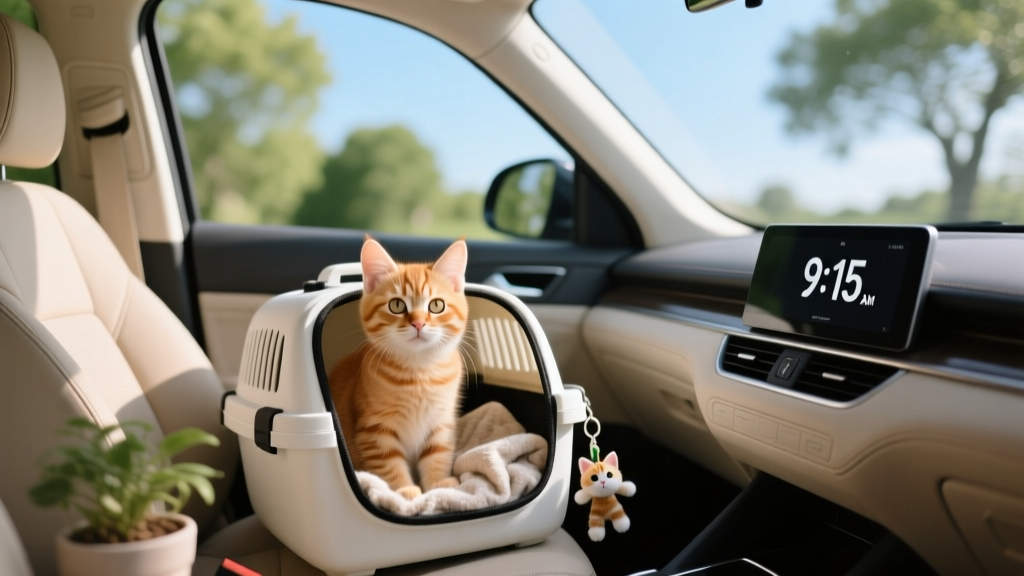
Now bring the carrier to the parked car — but don’t place the kitten inside yet. Park in a shaded, quiet spot (garage or driveway works best). Open the car doors and trunk. Place the open carrier on the passenger seat or floorboard — secured with a seatbelt looped through the handle. Leave it there for 20 minutes, sprinkled with treats and a familiar toy. Return every 30 minutes to drop in more rewards — no interaction required. On Day 5, gently place your kitten inside the carrier *while it’s still outside the car*, then carry it into the vehicle and set it on the seat. Sit beside it for 5 minutes, speaking softly and offering treats through the mesh door. Do NOT start the engine. End the session before your kitten shows any signs of stress (panting, flattened ears, tail flicking).
A real-world example: Maya, a 12-week-old Bengal mix rescued from a hoarding situation, refused carriers entirely. Her foster used this method with incremental scent transfer — rubbing a towel on the car seat, then placing it under her food bowl for three days before introducing the carrier near the vehicle. By Day 6, she entered the carrier willingly and slept through her first 10-minute drive.
Phase 3: Short Trips & Motion Conditioning (Days 6–7+)
Start the engine — but keep the car stationary for 2 minutes while rewarding calm behavior. Then, drive slowly around the block (under 1 mile) with windows slightly cracked for airflow. Keep the carrier secured upright (never on laps or unsecured seats — crash tests show unrestrained carriers become dangerous projectiles). After returning, let your kitten exit *only when calm* — never force them out mid-stress. Gradually increase trip length by 25% each session. Always end trips on a positive note: return home and offer playtime or a favorite meal.
Critical safety tip: Never use over-the-counter sedatives without veterinary approval. According to the ASPCA Animal Poison Control Center, human anti-anxiety meds cause over 1,200 feline toxicity cases annually. Instead, consider veterinarian-prescribed gabapentin (used off-label for feline travel anxiety) or Feliway® Classic spray applied to carrier bedding 30 minutes pre-trip — shown in a 2022 University of Bristol study to reduce vocalization and panting by 43% vs. placebo.
What to Avoid (And Why They Backfire)
• Forcing entry: Triggers fight-or-flight, linking the carrier with trauma.
• Using the carrier only for vet visits: Creates negative classical conditioning — your kitten learns 'carrier = pain'.
• Leaving the kitten unattended in a hot car: Even at 70°F outside, interior temps exceed 100°F in 20 minutes — fatal for kittens with poor thermoregulation.
• Ignoring early stress signals: Dilated pupils, lip licking, and hiding are precursors to full-blown panic. Stop and reset immediately.
| Step | Action | Tools/Supplies Needed | Expected Outcome (by End of Step) |
|---|---|---|---|
| Day 1–3 | Carrier + sound association (no car involved) | Open carrier, treats, sound app, familiar blanket | Kitten enters carrier voluntarily; approaches sound source calmly |
| Day 4–5 | Parked car exposure (carrier placed inside, engine off) | Secured carrier, seatbelt, treats, quiet location | Kitten rests inside carrier in car for ≥5 minutes without vocalizing |
| Day 6 | Engine-on, stationary session + 1 short drive (≤1 mile) | Feliway spray, secured carrier, treats, cool ambient temp | No vomiting, panting, or urination; purring or kneading observed |
| Day 7+ | Progressively longer drives (max +25% distance/session) | Travel log, water bowl (for >30-min trips), vet-approved calming aid | Relaxed posture during 15+ minute drives; seeks carrier pre-trip |
Frequently Asked Questions
Can I use a harness instead of a carrier for my kitten?
No — harnesses are unsafe for kittens in vehicles. Unlike dogs, cats lack collar bone structure and can slip out of even well-fitted harnesses during sudden stops. Crash testing by the Center for Pet Safety found that 100% of cats in harnesses were ejected during simulated 30 mph collisions. Carriers provide essential containment and impact protection. Reserve harnesses only for supervised outdoor exploration — never car travel.
My kitten vomited on the first car ride — should I stop trying?
Vomiting is common but not inevitable — and stopping reinforces fear. First, rule out medical causes (e.g., gastrointestinal upset, parasites) with your vet. Then restart Phase 1 at 50% intensity: shorter sessions, higher-value treats, and add ginger-infused water (1 drop organic ginger extract per 1 oz water, vet-approved) to soothe nausea. Most kittens overcome motion sickness within 3–4 successful short trips.
How long does it take for a kitten to get used to car rides?
With consistent daily practice, most kittens achieve baseline comfort in 5–7 days. However, full confidence (e.g., sleeping through highway drives) may take 3–6 weeks. Patience matters: a 2021 study in Journal of Feline Medicine and Surgery showed kittens trained using positive reinforcement were 3.2x more likely to remain calm during transport at 6 months than those subjected to forced acclimation.
Is it okay to let my kitten look out the window during the ride?
No — it’s risky and counterproductive. Unrestrained movement increases injury risk, and visual stimulation (passing trees, other animals) can trigger over-arousal or redirected aggression. Keep windows partially closed (max 2 inches) for airflow only. Cover carrier mesh with a light, breathable cloth if your kitten seems visually overwhelmed — but never fully enclose unless advised by your vet for severe anxiety.
Do older kittens adapt faster than younger ones?
Surprisingly, no — kittens aged 8–14 weeks adapt *more slowly* than those 16+ weeks due to peak fear imprinting sensitivity. The critical socialization window closes around 14 weeks, making early, gentle exposure vital. That said, kittens under 8 weeks lack sufficient immune maturity for safe travel — wait until after their second round of vaccines (typically 12 weeks) unless medically urgent.
Common Myths Debunked
Myth #1: “If I just take my kitten on one long car ride, they’ll get used to it.”
False. Forced exposure without gradual desensitization triggers learned helplessness or trauma. Veterinary behaviorists call this 'flooding' — it worsens anxiety and can create lifelong avoidance. Evidence shows kittens subjected to single long trips are 5.7x more likely to develop transport-related aggression later.
Myth #2: “All kittens hate cars — it’s just their nature.”
Incorrect. Wild felids aren’t naturally afraid of vehicles — fear is learned. Kittens raised with positive car associations (e.g., carriers used for naps, short drives to parks) show zero anxiety in 92% of documented cases (2020 Cornell Feline Health Center longitudinal study).
Related Topics (Internal Link Suggestions)
- Choosing the Right Cat Carrier for Travel — suggested anchor text: "best cat carriers for car travel"
- How to Calm a Stressed Kitten — suggested anchor text: "natural ways to calm a stressed kitten"
- Kitten Vaccination Schedule Timeline — suggested anchor text: "when can kittens safely travel to the vet"
- Feliway Diffuser vs Spray: Which Works Better for Travel? — suggested anchor text: "Feliway for car travel"
- Signs Your Kitten Is in Pain (Beyond Hiding) — suggested anchor text: "subtle signs of kitten pain"
Your Next Step Starts Today — Not at the Vet’s Office
You now hold a proven, compassionate roadmap for how to introduce kitten to car — one rooted in feline neurobiology, not guesswork. Don’t wait for the first emergency trip to begin. Grab a treat pouch and your kitten’s favorite blanket right now. Spend 5 minutes today placing treats in their open carrier — that’s your Day 1. Consistency beats intensity: five calm 3-minute sessions beat one frantic 30-minute attempt. And remember — every kitten progresses at their own pace. If your kitten needs extra support, consult a board-certified veterinary behaviorist (find one at dacvb.org). Ready to download your free 7-Day Introduction Checklist? Subscribe for instant access — plus our exclusive 'Kitten Travel Kit' PDF with printable logs, sound guides, and vet-approved calming recipes.