How to Interpret Cat Behavior Non-Toxic
Why Interpreting Cat Behavior Non-Toxic Isn’t Just Kind — It’s Essential
\nIf you’ve ever wondered how to interpret cat behavior non-toxic, you’re not just searching for translation—you’re seeking trust. Cats don’t misbehave; they communicate distress, confusion, or unmet needs in ways we often misread as defiance. Yet nearly 68% of cats surrendered to shelters are labeled ‘aggressive’ or ‘untrainable’—not because they’re flawed, but because their humans misinterpreted signals like flattened ears or redirected biting as malice, not fear. The truth? Every hiss, stare, or sudden zoomie is data—not drama. And interpreting that data without toxicity—no punishment, no coercion, no chemical suppressants—is the single most powerful shift you can make for your cat’s long-term mental health and your shared bond.
\n\nYour Cat’s Body Language Is a Real-Time Emotional Dashboard
\nCats evolved as both predator and prey—so their communication is subtle, layered, and highly context-dependent. Unlike dogs, who broadcast emotions broadly, cats calibrate signals to avoid drawing attention. That means a ‘neutral’ posture may actually signal high vigilance—and a ‘relaxed’ pose could mask chronic stress. Dr. Sarah H. Heath, a European College of Veterinary Behavioural Medicine diplomate, emphasizes: “Cats rarely escalate to aggression without warning. We miss those warnings because we’re looking for human-style cues—like yelling or stomping—not micro-expressions like third-eyelid exposure or whisker retraction.”
\n\nStart with the ‘Big Five’ nonverbal anchors:
\n- \n
- Ears: Forward and upright = engaged curiosity; swiveling independently = environmental scanning; pinned flat = acute fear or defensive readiness (not ‘anger’) \n
- Tail: Upright with quiver = affectionate greeting; low and twitching at tip = focused arousal (hunting or annoyance); puffed and low = terror or defensive threat \n
- Eyes: Slow blink = trust signal (‘cat kiss’); wide-open with dilated pupils = hyperarousal (fear or excitement); half-closed with squint = contentment or mild discomfort (context matters!) \n
- Posture: Crouched low with tucked legs = conflict avoidance; arched back + sideways stance = ‘startle response’ (not dominance); stretched out belly-up = deep trust *only if* the cat initiates contact—never assume it invites belly rubs \n
- Vocalizations: Purring isn’t always happy—it occurs during labor, injury, and vet visits as a self-soothing mechanism; chirps/chatters indicate frustrated predatory drive, not ‘talking’ \n
A real-world case: Luna, a 3-year-old rescue tabby, began urinating outside her litter box after her owner installed a motion-activated air freshener. The owner assumed ‘spite.’ A certified feline behaviorist observed Luna flinching at the device’s hiss and noted her tail-tip twitching constantly near the bathroom door—a sign of sustained low-grade anxiety. Removing the air freshener and adding a second, uncovered litter box resolved the issue in 4 days. No medication. No punishment. Just interpretation.
\n\nThe 4 Toxic Assumptions That Sabotage Accurate Interpretation
\nWe unintentionally poison our understanding when we project human motives onto cats—or worse, apply outdated training logic. Here’s what to unlearn:
\n- \n
- “Cats are aloof by nature” → False. They form secure attachments comparable to dogs and infants (per 2019 Oregon State University attachment study), but express them through proximity, synchronous sleeping, and greeting rituals—not clinginess. \n
- “If I ignore bad behavior, it’ll stop” → Dangerous oversimplification. Ignoring a cat’s yowl at 3 a.m. may reinforce it—if the yowl previously got food or attention. But ignoring a cat hiding under the bed after a thunderstorm? That’s abandonment of emotional support. \n
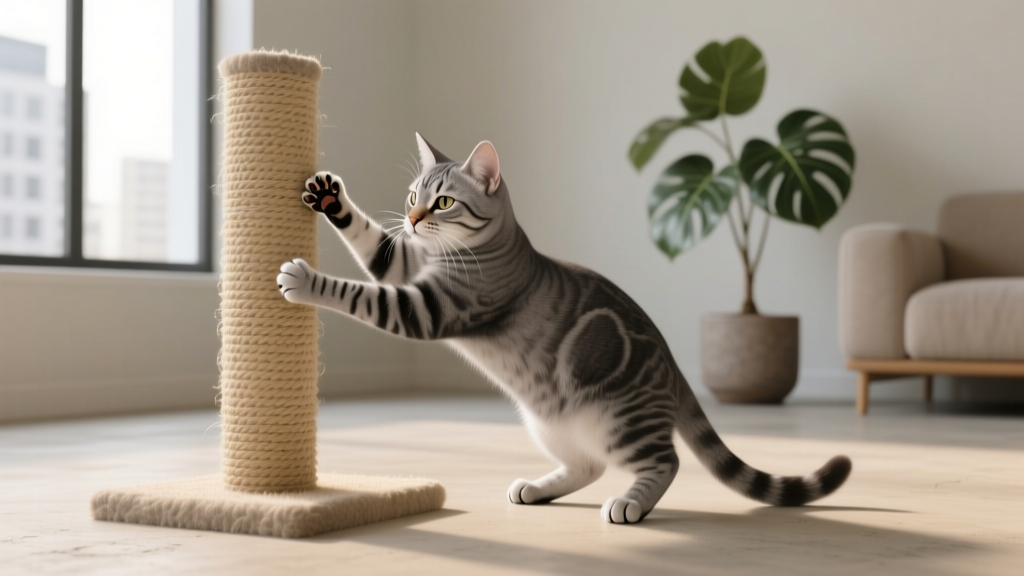
- “Scratching furniture means they’re destructive” → Inaccurate. Scratching serves scent-marking, claw maintenance, and spinal stretching. The ‘problem’ isn’t the cat—it’s the absence of appropriate, appealing alternatives placed where the cat already prefers to scratch. \n
- “Hissing = aggression that must be corrected” → Harmful. Hissing is a clear, functional boundary signal. Punishing it teaches the cat to skip the warning and go straight to biting—making interactions less predictable and more dangerous. \n
Non-toxic interpretation starts with replacing judgment with inquiry: What need is this behavior meeting? What changed in the environment? When did this start—and what happened right before? Keep a 7-day ‘Behavior Log’ noting time, location, trigger (if visible), your response, and your cat’s immediate reaction. Patterns emerge fast—and they’re almost never about ‘personality.’
\n\nDecoding Context: Why the Same Signal Means 5 Different Things
\nA tail held high means confidence… unless your cat is recovering from surgery and holding it stiffly to avoid pain. A purr means contentment… unless your senior cat is purring while breathing rapidly and refusing food (a red flag for underlying illness). Context transforms meaning. Consider these three dimensions every time you observe behavior:
\n- \n
- Environmental context: New pet? Construction noise? Changed litter brand? Even seasonal shifts alter light cycles and indoor humidity—both impact feline stress hormones. \n
- Physical context: Age, mobility, dental pain, arthritis, or hyperthyroidism can manifest as ‘grumpiness’ or ‘litter box avoidance.’ A 2022 Journal of Feline Medicine & Surgery study found 41% of cats diagnosed with behavioral issues had undiagnosed medical conditions. \n
- Relationship context: Does your cat only bite when you reach for their collar—but tolerates brushing? That’s not ‘bad behavior’—it’s precise, consistent communication: “I consent to touch here, not there.” \n
Try the ‘Three-Second Rule’ before interaction: Pause, observe for 3 seconds, then ask: Is their body soft or tense? Are their eyes relaxed or darting? Is their tail still or flicking? If any element reads ‘uncertain,’ wait. Let them initiate. This builds predictive safety—the foundation of non-toxic trust.
\n\nNon-Toxic Interpretation in Action: A Step-by-Step Response Framework
\nWhen your cat displays confusing or challenging behavior, follow this proven framework—developed by the International Society of Feline Medicine and used in over 200 veterinary behavior clinics worldwide:
\n| Step | \nAction | \nTools/Support Needed | \nExpected Outcome (Within 72 Hours) | \n
|---|---|---|---|
| 1. Pause & Observe | \nStop all interaction. Note duration, frequency, and immediate antecedents (what happened 5–30 sec before). | \nSmartphone voice memo or notebook; timer app | \nClear baseline data; reduced human-triggered escalation | \n
| 2. Rule Out Medical Cause | \nSchedule vet visit focusing on pain assessment (orthopedic, dental, urinary) and thyroid panel—even for ‘behavioral’ concerns. | \nVeterinary exam + diagnostics; list of observed behaviors | \nMedical condition identified or ruled out; treatment plan initiated if needed | \n
| 3. Identify Function | \nAsk: Is this behavior gaining something (attention, food, escape) or avoiding something (noise, handling, confinement)? | \nBehavior log; certified feline behavior consultant (IAABC directory) | \nConfirmed motivation (e.g., ‘yowling = seeking attention at night’ vs. ‘yowling = pain response’) | \n
| 4. Modify Environment | \nAdd resources (litter boxes, perches, hiding spots) and remove triggers (loud appliances, unfamiliar scents, visual access to outdoor cats). | \nCardboard boxes, Feliway diffusers, window film, vertical space kits | \nReduction in frequency/intensity of behavior; increased use of designated zones | \n
| 5. Reinforce Alternatives | \nClicker-train or reward desired behaviors (e.g., using scratching post, entering carrier voluntarily) using high-value treats (chicken, tuna, freeze-dried liver). | \nClicker or marker word, treat pouch, 5-min daily sessions | \nIncreased repetition of alternative behavior; decreased reliance on problematic one | \n
This framework works because it treats behavior as communication—not disobedience. Notice zero steps involve punishment, aversives, or suppression. Instead, it prioritizes safety, predictability, and choice—the pillars of feline welfare. As Dr. Mikel Delgado, Certified Applied Animal Behaviorist, states: “Cats don’t need obedience. They need clarity, control, and compassion.”
\n\nFrequently Asked Questions
\nCan I use pheromone diffusers like Feliway as part of non-toxic behavior interpretation?
\nYes—when used appropriately. Feliway Classic mimics facial pheromones cats deposit when feeling safe, helping reduce stress-related behaviors like spraying or hiding. But crucially: it’s not a ‘fix’ for misinterpreted signals. It supports environmental safety *while* you learn your cat’s language. Never use it to mask untreated anxiety or replace behavioral assessment. Always pair with observation and environmental enrichment.
\nMy cat bites me gently during petting—does that mean they love me or want me to stop?
\nAlmost always the latter. Known as ‘petting-induced aggression,’ this is a classic overstimulation signal—not affection. Cats have sensitive nerve endings along their backs and tails; prolonged stroking triggers discomfort. Watch for early signs: tail flicking, skin rippling, flattened ears, or sudden stillness. Stop *before* the bite—and reward calm disengagement with a treat. Over time, gradually increase tolerance by ending sessions *just before* the signal appears.
\nIs it okay to use a spray bottle to stop scratching or jumping on counters?
\nNo—it’s toxic to the relationship and counterproductive. Spray bottles cause fear, erode trust, and teach cats to hide behavior—not change it. Worse, they associate *you*, not the surface, with punishment. Studies show cats subjected to punishment-based methods develop higher cortisol levels and increased avoidance behaviors. Instead, make undesirable surfaces unappealing (double-sided tape, aluminum foil) and desirable ones irresistible (cat trees near windows, food puzzles on counters).
\nHow do I know if my cat’s ‘lazy’ behavior is normal or a sign of depression?
\nTrue feline depression is rare—but lethargy, appetite loss, excessive sleeping, or withdrawal *can* signal pain, illness, or profound environmental stress (e.g., grief after losing a companion). Track changes: Has activity dropped >30% over 2 weeks? Is grooming neglected? Are they avoiding favorite spots? Rule out medical causes first. Then assess environmental enrichment: Do they have vertical space, novel scents (catnip, silvervine), prey-like toys, and safe outdoor access (catio, harness walks)? Boredom is often mistaken for sadness.
\nCan kittens be taught non-toxic communication early?
\nAbsolutely—and it’s critical. Kittens aged 2–7 weeks are in a prime socialization window. Introduce handling, carriers, and nail trims paired with treats and praise. Let them retreat freely. Never force interaction. This builds lifelong resilience and makes future interpretation infinitely easier. A 2020 study in Applied Animal Behaviour Science found kittens handled gently for 15 mins/day during this period showed 73% less stress during vet visits at 1 year old.
\nCommon Myths About Cat Behavior
\nMyth #1: “Cats don’t form bonds with people—they just tolerate us for food.”
Debunked: fMRI studies confirm cats show neural activation in reward centers when hearing their owner’s voice—similar to dogs and human infants. They choose attachment, not convenience.
Myth #2: “If a cat doesn’t like you, they’ll hiss or swipe immediately.”
Debunked: Most cats avoid confrontation entirely. Early signs of discomfort include lip licking, turning head away, freezing, or slow blinking *away* from you—subtle signals easily missed without non-toxic observation practice.
Related Topics (Internal Link Suggestions)
\n- \n
- Feline Stress Signals — suggested anchor text: "subtle signs your cat is stressed" \n
- Cat Body Language Dictionary — suggested anchor text: "what does a cat's tail position really mean?" \n
- Enrichment Ideas for Indoor Cats — suggested anchor text: "indoor cat enrichment activities that reduce boredom" \n
- How to Introduce a New Pet to Your Cat — suggested anchor text: "stress-free cat introduction guide" \n
- When to See a Veterinary Behaviorist — suggested anchor text: "signs your cat needs a behavior specialist" \n
Conclusion & Your Next Step
\nLearning how to interpret cat behavior non-toxic isn’t about becoming a mind reader—it’s about becoming a respectful listener. It means trading assumptions for observation, punishment for patience, and frustration for fascination. Every flick of an ear, every slow blink, every carefully placed paw tells a story your cat trusts you to hear. Start today: pick one behavior you’ve labeled ‘annoying’ or ‘confusing,’ and apply the 3-Second Rule. Observe without agenda. Note context. Then respond—not with correction, but with care. Your cat won’t thank you with words. But they’ll show up more, relax deeper, and choose you—again and again—in the quiet, confident language only they speak.