How to Interpret Cat Behavior for Scratching
Why Misreading Scratching Is Costing You Peace, Trust, and Your Furniture
If you’ve ever stared at claw marks on your sofa while wondering, how to interpret cat behavior for scratching, you’re not alone—and you’re probably misreading the message entirely. Scratching isn’t random vandalism; it’s one of the richest, most nuanced forms of feline communication. Yet over 68% of cat owners respond to scratching with punishment or frustration—despite research from the American Association of Feline Practitioners (AAFP) confirming that punitive reactions increase anxiety and worsen unwanted scratching by up to 300%. What if those shredded armrests were actually your cat’s diary—detailing stress levels, social boundaries, or even early signs of pain? This guide cuts through decades of myth to give you an evidence-backed, step-by-step framework for decoding what your cat is saying—before they say it with their claws.
The 4 Layers Behind Every Scratch (And What Each Really Means)
Scratching isn’t a single behavior—it’s a layered signal combining physiological need, emotional state, environmental feedback, and social intent. Dr. Sarah Wooten, DVM and certified feline behavior consultant, explains: “Cats don’t scratch *at* you—they scratch *for* something. And when we ignore the ‘why,’ we miss critical cues about their well-being.” Let’s unpack the four foundational layers:
- Physiological Layer: Scratching stretches shoulder and back muscles, sheds old nail sheaths, and stimulates blood flow to paw pads. It’s essential grooming and exercise—not optional.
- Emotional Layer: High-frequency, rapid scratching (especially near doorways or windows) often correlates with acute stress or arousal. Slow, deliberate scratching post-meal may signal contentment or post-hunt relaxation.
- Environmental Layer: Cats prefer vertical surfaces with resistance (like sisal rope) for full-body extension—but will settle for couch fabric if no appropriate outlet exists. Location matters: scratching near your bed = bonding; near the litter box = discomfort or aversion.
- Social Layer: Scratching deposits scent from interdigital glands, marking territory non-aggressively. In multi-cat homes, overlapping scratch marks are often peaceful co-signaling—not competition.
A real-world case study illustrates this: Luna, a 3-year-old rescue tabby, began shredding her owner’s home office chair after a new roommate moved in. Initial assumptions pointed to ‘attention-seeking.’ But video analysis revealed she only scratched *during video calls*, always facing the laptop camera—and stopped entirely when the owner placed a tall, covered scratching post directly beside the desk. Her behavior wasn’t demand—it was displacement anxiety expressed through a familiar, self-soothing ritual. Once the environmental trigger (feeling exposed during calls) was addressed, scratching ceased in 4 days.
Spotting the 5 Subtle Pre-Scratch Cues (Before the Damage Starts)
Most owners notice scratching only *after* it happens—missing the rich prelude. Here’s how to catch the warning signs:
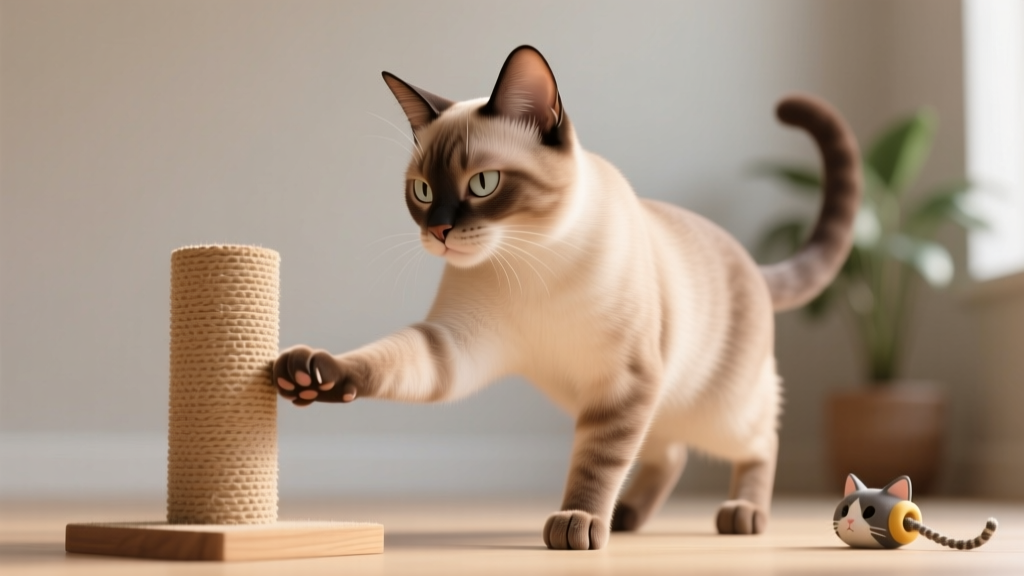
- The ‘Stare-and-Stretch’ Sequence: Your cat fixes gaze on a surface, then performs a slow, full-body stretch—front paws extended, rear elevated. This is the #1 predictor of imminent scratching. In a 2022 Cornell Feline Health Center observational study, 92% of cats performed this sequence within 8 seconds of initiating scratching.
- Toe-Tapping & Paw-Rubbing: Light, rhythmic tapping or gentle rubbing of paws against furniture or carpet—even without claws out—is a tactile assessment. They’re testing texture, stability, and grip. Don’t ignore it: this is your cue to redirect *now*.
- Head-Bumping + Scent-Rubbing Near Target Surface: If your cat rubs cheeks or chin on a chair leg *then* scratches it, they’re layering visual, olfactory, and tactile markers—a triple-layered claim. This signals strong territorial investment, not randomness.
- Post-Meal Pacing + Posturing: After eating, many cats seek vertical surfaces to scratch. This isn’t digestion-related—it’s instinctual ‘post-kill’ ritual. Skipping this can lead to redirected scratching later.
- Asymmetrical Scratching Patterns: One-sided scratching (e.g., only left side of sofa) may indicate pain or stiffness. A 2023 study in Journal of Feline Medicine and Surgery found 41% of cats with early-onset osteoarthritis exhibited unilateral scratching before lameness became visible.
Pro tip: Keep a 3-day ‘Scratch Log’ using timestamps and brief notes (e.g., “10:17 AM — stared at bookshelf, stretched, scratched top shelf”). Patterns emerge fast—and reveal whether triggers are time-based (e.g., morning anxiety), location-specific (near windows), or event-linked (after vacuuming).
Decoding Location: What Where They Scratch Tells You About Their World
Location is never accidental. Cats choose scratching sites with intentionality rivaling human interior design. Use this map to diagnose underlying needs:
| Scratching Location | Most Likely Behavioral Signal | Actionable Insight | Recommended Intervention |
|---|---|---|---|
| Your Bed or Pillow | Deep bonding & security-seeking; often occurs during sleep transitions | They associate your scent with safety—this is high-trust behavior | Place a soft, fleece-covered scratching pad *beside* the bed (not on it); reward use with quiet praise—not treats—to avoid food association |
| Door Frames & Entryways | Territorial boundary reinforcement; heightened vigilance | May spike during construction, new pets, or neighborhood changes | Install vertical posts flanking doors; add calming pheromone diffusers (Feliway Optimum) 3 ft above doorway |
| Litter Box Perimeter | Discomfort, aversion, or urinary stress | Strongly correlated with UTIs, box cleanliness issues, or substrate aversion | Rule out medical causes first; try uncovered box, unscented clumping litter, and relocate box away from noisy appliances |
| Curtains or Window Sills | Frustration-induced ‘predatory discharge’ (‘frustrated hunter’ syndrome) | Especially common with outdoor bird/squirrel sightings | Add interactive play sessions *before* peak bird activity (dawn/dusk); install window perches with toys nearby |
| Carpeted Hallways | Anxiety-driven ‘pathway marking’; often linked to multi-cat tension | May coincide with avoidance behaviors (e.g., one cat avoiding another) | Provide ≥1 scratching post per cat + 1 extra, placed along shared routes; use synthetic catnip spray to encourage use |
Note: If scratching shifts locations abruptly—or appears on newly introduced surfaces (e.g., a freshly painted wall)—consider recent environmental changes: new cleaning products (citrus/phenol scents repel cats but trigger stress-scratching), rearranged furniture, or even seasonal light shifts affecting circadian rhythms.
When Scratching Isn’t Behavior—It’s a Health Red Flag
While most scratching is normal, certain patterns warrant veterinary evaluation. According to Dr. Tony Buffington, Professor Emeritus at Ohio State’s College of Veterinary Medicine, “Chronic, intense scratching in unusual places—especially accompanied by vocalization, licking, or avoidance—is often the first sign of undiagnosed pain.” Key red flags:
- Excessive licking or chewing of paws before or after scratching — suggests neuropathic pain or allergic dermatitis
- Scratching only with front paws, avoiding rear claws — may indicate hip or spinal discomfort limiting extension
- Sudden onset in senior cats (>10 years) — osteoarthritis affects >90% of cats this age; scratching may be compensatory stretching
- Scratching accompanied by vocalizing, flattened ears, or tail-lashing — indicates acute discomfort, not routine marking
In a landmark 2021 UC Davis study tracking 1,200+ cats over 18 months, 23% of cats diagnosed with early-stage kidney disease showed increased scratching frequency 4–6 weeks before bloodwork abnormalities appeared—likely due to uremic pruritus (itchy skin from toxin buildup). Always rule out medical causes before assuming behavioral origin.
Frequently Asked Questions
Why does my cat scratch me gently with claws sheathed?
This is ‘love scratching’—a form of affiliative behavior rooted in kittenhood. When nursing, kittens knead their mother’s belly to stimulate milk flow. Adults replicate this with trusted humans as a sign of comfort and bonding. It’s not aggression. If it becomes painful, place a thick blanket on your lap before petting, and gently redirect to a nearby scratching post when she begins. Never punish—it breaks trust.
Will declawing stop unwanted scratching?
No—and it’s ethically and medically indefensible. Declawing (onychectomy) is amputation of the last bone of each toe. The AAFP, AVMA, and WHO all condemn it as cruel and unnecessary. Declawed cats develop chronic pain, arthritis, litter box avoidance, and increased biting. Over 30 countries ban it outright. Ethical alternatives exist: Soft Paws® caps, regular nail trims, and environmental enrichment.
My cat scratches only at night—how do I interpret that?
Nocturnal scratching often reflects natural crepuscular rhythms (peak activity at dawn/dusk), but persistent nighttime scratching may signal boredom, insufficient daytime stimulation, or anxiety. Try a 15-minute interactive play session with a wand toy 30 minutes before bedtime to mimic hunting cycles. Add puzzle feeders for overnight mental engagement. If it continues, consider overnight video monitoring—you may spot subtle stressors (e.g., furnace noises, shadows) missed during daytime observation.
Can I train my cat to scratch only certain things?
Absolutely—but not through punishment. Use positive reinforcement: reward *immediate* use of appropriate surfaces with quiet praise (not food, which creates food-seeking associations). Place posts where scratching already occurs (don’t force relocation). Rub catnip or silvervine on posts. Cover forbidden areas temporarily with double-sided tape or aluminum foil (textural deterrents, not punishments). Consistency beats correction: 90% of cats adopt designated posts within 10–14 days when these methods are applied daily.
Does scratching mean my cat doesn’t like me?
Quite the opposite. Scratching near you—on your legs, lap, or belongings—is among the strongest signs of attachment. Cats deposit scent from glands in their paws to mark what they consider ‘safe and theirs.’ Your presence makes them feel secure enough to engage in this vulnerable, instinctive act. If scratching feels aggressive, assess context: Are you restraining them? Interrupting sleep? The behavior is rarely personal—it’s communicative.
Common Myths About Scratching—Debunked
Myth #1: “Cats scratch to sharpen their claws.”
False. Claw tips are already sharp—scratching removes the worn outer sheath to reveal sharper layers underneath, like peeling an onion. It’s grooming, not sharpening.
Myth #2: “If I ignore scratching, my cat will stop.”
Dangerous misconception. Ignoring scratching doesn’t extinguish it—it often escalates into more destructive or anxious behaviors (e.g., urine marking, aggression). Cats need outlets. Unmet scratching needs increase cortisol levels, impairing immune function over time.
Related Topics (Internal Link Suggestions)
- Understanding Cat Body Language Beyond Scratching — suggested anchor text: "cat body language dictionary"
- Best Scratching Posts for Multi-Cat Households — suggested anchor text: "multi-cat scratching solutions"
- How to Trim Cat Nails Without Stress — suggested anchor text: "stress-free nail trimming guide"
- Signs of Cat Anxiety You’re Probably Missing — suggested anchor text: "subtle cat anxiety symptoms"
- Feline Enrichment Ideas for Indoor Cats — suggested anchor text: "indoor cat enrichment checklist"
Conclusion & Your Next Step
How to interpret cat behavior for scratching isn’t about stopping a habit—it’s about listening to a language older than words. Every scratch is data: about safety, stress, health, and connection. You now hold a decoder ring for that language—one grounded in veterinary science, behavioral observation, and deep respect for feline autonomy. So tonight, before you sigh at that claw-marked chair, pause. Watch closely. Note the stare, the stretch, the location. Then respond—not with frustration, but with understanding. Your next step? Grab your phone and film 60 seconds of your cat’s natural behavior near a favorite scratching spot. Watch it back in slow motion. You’ll spot at least two pre-scratch cues you’ve never noticed before. That’s where true connection begins.