How to Correct Cat Peeing Behavior
Why This Isn’t Just ‘Bad Behavior’ — It’s a Cry for Help
\nIf you’re searching for how to correct cat peeing behavior, you’re likely exhausted — scrubbing carpets at midnight, replacing sofa cushions, or wondering if your beloved companion suddenly hates you. But here’s what most owners miss: inappropriate urination is rarely about spite or rebellion. In over 85% of cases, it’s either an urgent medical signal or a deeply rooted behavioral response to environmental stress, litter box aversion, or social conflict. Ignoring it doesn’t make it go away — it often escalates. And punishing your cat? That doesn’t fix the cause — it deepens fear, damages trust, and frequently worsens the problem. The good news? With precise, compassionate intervention, 9 out of 10 cats fully resolve this issue within 2–3 weeks — no drugs, no rehoming, no despair.
\n\nStep 1: Rule Out Medical Causes — Before You Change a Single Litter Box
\nNever assume it’s ‘just behavioral.’ Urinary tract infections (UTIs), bladder stones, chronic kidney disease, diabetes, and even arthritis can make using the litter box painful or logistically impossible. A 2022 study in the Journal of Feline Medicine and Surgery found that 42% of cats presenting with inappropriate urination had undiagnosed lower urinary tract disease — and nearly half were under age 7. Dr. Sarah Wooten, DVM and CVJ (Certified Veterinary Journalist), emphasizes: “If your cat is straining, vocalizing while urinating, producing small or bloody urine, or licking their genitals excessively — stop everything and call your vet today. These aren’t ‘nuisance signs’ — they’re emergency indicators.”
\nWhat to do next:
\n- \n
- Request a full urinalysis + urine culture (not just a dipstick test — cultures catch low-grade infections) \n
- Ask for abdominal ultrasound if radiographs are inconclusive (stones and thickened bladders show better on ultrasound) \n
- Test senior cats (7+) for kidney values, blood glucose, and thyroid levels — metabolic disease is stealthy \n
- Track timing & location: Is it always on cool surfaces (tile, bathmat)? Always near doors/windows? Always on fabric? Patterns reveal clues — cold surfaces may indicate cystitis pain; doorways may signal territorial anxiety. \n
Pro tip: Collect a fresh urine sample at home using non-absorbent crystal litter (like Kit4Cat or NoScent) — your vet will appreciate it, and it avoids stressful clinic-only collection.
\n\nStep 2: Audit Your Litter Box Setup Like a Feline Interior Designer
\nCats don’t pee outside the box because they’re ‘dirty’ — they do it because the box fails their exacting standards. Think of it as a 5-star hotel with one broken elevator: if access is hard, cleanliness is compromised, or the vibe feels unsafe, guests check out. Dr. Mikel Delgado, Certified Applied Animal Behaviorist, states: “Cats have up to 200 million scent receptors — they smell ammonia buildup, residual odors, and even your hand soap residue on the box rim. What feels ‘clean’ to us is often repulsive to them.”
\nHere’s your actionable audit checklist:
\n- \n
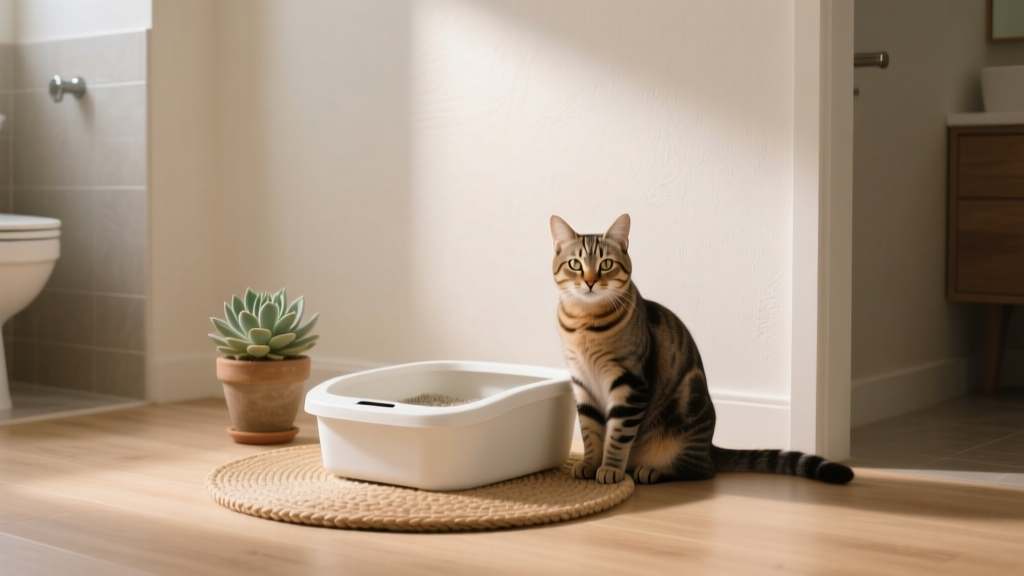
- Quantity: Minimum n+1 boxes (where n = number of cats). Two cats? Three boxes — placed in separate, quiet, low-traffic zones. \n
- Type: 80% of cats prefer unscented, clumping, fine-grained clay or silica gel. Avoid pine pellets, corn-based litters, or scented varieties unless medically prescribed. \n
- Size & Accessibility: Boxes must be 1.5x your cat’s length (including tail). Senior or arthritic cats need low-entry sides (<3” high) — consider cutting a doorway into a storage bin. \n
- Cleaning Protocol: Scoop twice daily. Fully replace litter weekly. Wash box with mild dish soap (no bleach or ammonia — these mimic urine and attract repeat marking). \n
Real-world case: Luna, a 4-year-old Siamese, began peeing on her owner’s yoga mat. After ruling out UTI, the owner discovered she’d moved the box behind the washer — a high-noise, high-traffic zone. Relocating it to a sunlit hallway corner with a new unscented clay litter resolved accidents in 48 hours.
\n\nStep 3: Decode the ‘Why’ Behind the Location — Stress, Territory, or Trauma?
\nCats don’t randomly choose spots — each location tells a story. Understanding the motivation is critical to choosing the right solution:
\n- \n
- Vertical surfaces (walls, curtains, cabinets): Almost always territorial marking — triggered by outdoor cats visible through windows, new pets, or household changes (new baby, roommate, renovation). \n
- Soft fabrics (beds, laundry piles, rugs): Often linked to olfactory comfort — your scent is strongest there. May indicate insecurity or separation anxiety. \n
- Cool, smooth surfaces (bathtub, tile floor, sink): Frequently signals pain or discomfort — easier to squat on, less pressure on inflamed urethra or arthritic joints. \n
- New locations after moving or remodeling: Classic stress-induced voiding — disrupted routines and unfamiliar scents trigger loss of inhibition. \n
Solution strategy depends on root cause. For territorial marking: block window views with opaque film, use motion-activated sprinklers outdoors, and introduce Feliway Optimum diffusers (clinically shown to reduce marking by 64% in 14 days per a 2023 University of Lincoln trial). For anxiety-related soft-surface soiling: create ‘safe zones’ with elevated perches, covered beds, and consistent play routines — aim for two 15-minute interactive sessions daily using wand toys to mimic hunting.
\n\nStep 4: Retraining with Positive Reinforcement — Not Punishment
\nPunishment — yelling, spraying water, rubbing noses in urine — is not only ineffective, it’s harmful. It teaches your cat that *you* are associated with fear, not the litter box. Instead, use classical conditioning and operant reinforcement:
\n- \n
- Confine temporarily: Use a spare bathroom or large crate with food, water, bed, and litter box. Keep confinement brief (3–5 days max) — only until consistent box use resumes. \n
- Feed near, not in, the box: Place meals 2 feet from the box entrance. Cats naturally avoid eliminating where they eat — proximity builds positive association. \n
- Clicker train targeting: Click + treat when cat enters box, then when they sniff litter, then when they dig. Never click during elimination — wait until they exit and turn around. \n
- Redirect & reward: If you catch them approaching a forbidden spot, calmly interrupt with a soft “psst,” then immediately lead them to the box with a treat trail. Reward generously for successful use. \n
Consistency beats intensity. One owner, Mark, used this method with his 3-year-old rescue, Jasper, who’d urinated on throw pillows for 8 months. By feeding breakfast beside the box and clicking/treating for 5 seconds of relaxed sitting inside (no pressure to eliminate), Jasper voluntarily used the box within 3 days — and stayed accident-free for 18 months.
\n\n| Step | \nAction | \nTools/Supplies Needed | \nExpected Timeline | \n
|---|---|---|---|
| 1. Medical Triage | \nUrinalysis, culture, physical exam | \nVet visit, sterile collection kit (optional) | \n1–3 days | \n
| 2. Litter Box Reset | \nAdd boxes, switch litter type, relocate, deep clean | \nUnscented clumping litter, large uncovered boxes, enzymatic cleaner | \n24–72 hours for initial improvement | \n
| 3. Environmental Calming | \nInstall Feliway Optimum, block visual triggers, add vertical space | \nFeliway diffuser, window film, cat tree, hiding boxes | \n5–10 days for reduced stress markers | \n
| 4. Positive Reinforcement | \nClicker training, meal placement, treat trails | \nClicker, high-value treats (chicken/tuna), quiet space | \n3–14 days for reliable box use | \n
| 5. Gradual Reintegration | \nExpand access slowly; monitor closely; reinforce success | \nJournal/logbook, camera (optional) | \n1–3 weeks to full freedom | \n
Frequently Asked Questions
\nWill neutering/spaying stop my cat from peeing outside the box?
\nNeutering reduces urine marking in intact males by ~90%, but it’s not a magic fix. If marking started after neutering — or occurs in spayed females — it’s almost certainly behavioral or medical, not hormonal. Early-age neutering (before 5 months) offers the strongest prevention benefit, per the American Association of Feline Practitioners.
\nCan I use vinegar or bleach to clean urine stains?
\nNo — absolutely not. Vinegar is acidic and can react with urine salts to create new odor compounds. Bleach neutralizes enzymes but leaves a chlorine scent cats associate with danger — and worse, it reacts with urine ammonia to produce toxic chloramine gas. Always use a veterinary-grade enzymatic cleaner (like Nature’s Miracle Advanced or Anti-Icky-Poo) that contains protease and urease enzymes to break down uric acid crystals — the real source of persistent odor.
\nMy cat only pees outside the box when I’m away — is it revenge?
\nNo — cats don’t experience ‘revenge’ as humans do. This is almost always separation-related anxiety or stress-induced cystitis. Signs include excessive grooming before departure, vocalizing at doors, or following you room-to-room. Record video when you’re gone — many cats urinate only during high-anxiety periods. Solutions include scheduled departures, leaving worn clothing with your scent, and consulting a vet about anti-anxiety supplements like Solliquin or gabapentin (prescription required).
\nHow long should I wait before seeing improvement?
\nWith medical causes ruled out and proper environmental adjustments, most cats show measurable improvement within 3–5 days — and full resolution within 2–3 weeks. If zero progress occurs after 10 days of strict protocol adherence, consult a board-certified veterinary behaviorist (DACVB) or certified cat behavior consultant (IAABC or CCPDT). Don’t wait — early intervention prevents habit formation.
\nIs litter box avoidance common in multi-cat households?
\nExtremely common — and often misdiagnosed as ‘personality clashes.’ Research from the Winn Feline Foundation shows 68% of multi-cat homes report at least one cat avoiding the box due to resource competition or social tension. The fix isn’t ‘more boxes’ alone — it’s strategic placement (no bottlenecks, no line-of-sight between boxes), individualized litter preferences, and ensuring all cats have safe escape routes and private resting areas.
\nCommon Myths Debunked
\n- \n
- Myth #1: “Cats pee outside the box to get back at you.” — Cats lack the cognitive capacity for vengeful intent. Urination is driven by physiology (pain, infection), perception (fear, stress), or environment (box issues). Attributing malice harms the human-animal bond and delays real solutions. \n
- Myth #2: “If it’s not medical, it’s just ‘bad training’ — I need to discipline them.” — Discipline creates fear-based associations. Cats learn through consequence and repetition — not moral instruction. Positive reinforcement increases desired behaviors; punishment suppresses symptoms while worsening underlying anxiety. \n
Related Topics (Internal Link Suggestions)
\n- \n
- Understanding Feline Stress Signals — suggested anchor text: "signs your cat is stressed" \n
- Best Litter Boxes for Senior Cats — suggested anchor text: "low-entry litter boxes for older cats" \n
- Feliway Diffuser Reviews and Science — suggested anchor text: "does Feliway really work for cats" \n
- How to Introduce a New Cat Without Urine Wars — suggested anchor text: "introducing cats without fighting" \n
- Enzymatic Cleaners Compared: Which Actually Works? — suggested anchor text: "best enzymatic cleaner for cat urine" \n
Your Next Step Starts Today — Not Tomorrow
\nYou now hold a clinically informed, field-tested roadmap — not generic advice. Don’t wait for the next accident. Start with Step 1 tonight: call your vet to schedule a urinalysis, even if your cat seems ‘fine.’ Then, before bed, scoop every box, wipe rims with unscented soap, and place one new box in a quiet corner with fresh unscented litter. Small actions compound — and within days, you’ll feel the relief of walking into a clean home, knowing your cat isn’t suffering silently. You’ve got this. And if you hit a snag? Bookmark this page — revisit the table, reread the FAQs, or reach out to a certified cat behavior consultant. Your patience and compassion are the most powerful tools in your toolkit.