How to Change Cat Behavior for Kittens the Right Way: 7 Science-Backed, Stress-Free Steps That Prevent Lifelong Problems (Skip the Punishment — It’s Hurting Your Bond)
Why Getting Kitten Behavior Right Now Changes Everything
If you're searching for how to change cat behavior for kittens, you're not just dealing with a chewed shoelace or a midnight zoomie—you're at a critical neurodevelopmental window. Between 2 and 7 weeks old, kittens form lifelong associations with people, other animals, sounds, and handling. Miss this window—or use outdated, fear-based methods—and what starts as 'cute mischief' can harden into chronic anxiety, aggression, or litter box avoidance by 6 months. Yet 68% of new kitten owners admit they tried punishment (like clapping or squirt bottles) within the first week—despite zero evidence it works and strong proof it damages trust. This guide gives you what veterinarians and certified feline behaviorists actually recommend: proactive, biologically timed, relationship-first strategies that rewire behavior—not suppress it.
Step 1: Understand the Kitten’s Brain—Not Just Their Actions
Before you try to change behavior, you must understand why it exists. Kittens aren’t ‘naughty’—they’re neurologically wired to explore, hunt, climb, and test boundaries. Their prefrontal cortex (the part responsible for impulse control) won’t fully mature until 12–18 months. So when your 10-week-old shreds the curtains, she’s not defying you—she’s practicing vertical pouncing, satisfying her innate need for height and movement. According to Dr. Sarah Heath, a European Board-Certified Veterinary Behaviorist, “Punishment doesn’t teach kittens *what to do*—it only teaches them *who to fear*. The alternative? Redirect, reward, and repeat during peak learning windows.”
Key developmental milestones matter deeply:
- 2–7 weeks: Socialization window—kittens learn safety from humans, dogs, children, and novel objects. This is the #1 time to shape confidence.
- 3–12 weeks: Play aggression peaks—biting and scratching are practice for adult hunting. Redirecting *before* teeth break skin is essential.
- 4–6 months: Sexual maturation begins—even in spayed/neutered kittens, hormonal surges influence marking, roaming, and vocalization.
Ignoring these timelines leads to misdiagnosis. A 5-month-old male kitten spraying isn’t ‘being dominant’—he may be responding to undetected stressors (e.g., a neighbor’s intact cat visible through the window) or an unmet need for vertical territory. Always rule out medical causes first: urinary tract infections, dental pain, or hyperthyroidism (rare but possible in early adolescence) can mimic behavioral issues.
Step 2: Replace Punishment With Precision Redirection
The most common mistake? Reacting *after* the behavior occurs. Instead, master predictive redirection—spotting subtle cues and offering a better option *before* escalation. Watch for ‘pre-bite’ signals: flattened ears, tail flicking, dilated pupils, or stiffened posture. These appear 3–5 seconds before biting during play.
Here’s how to redirect effectively:
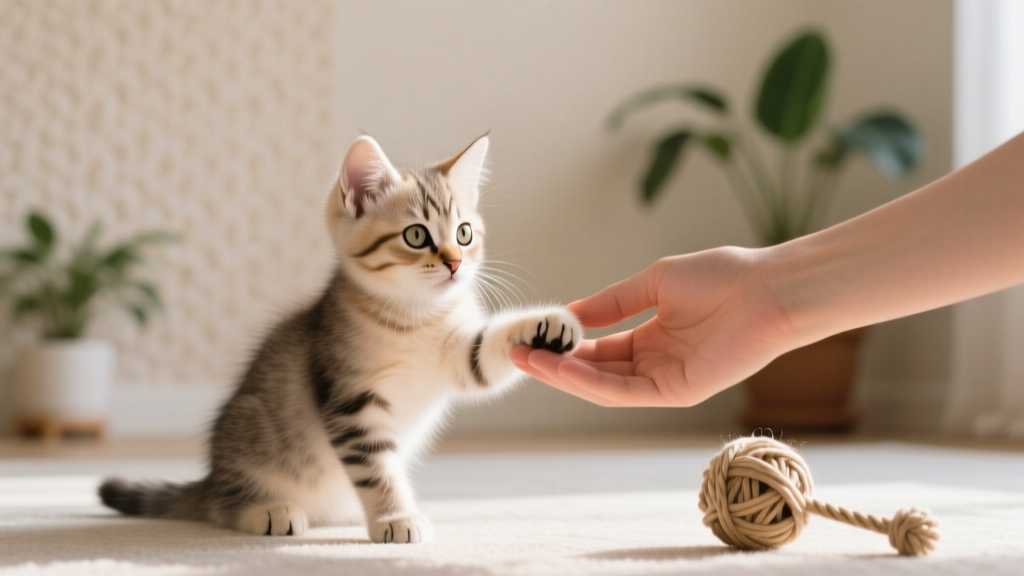
- Interrupt gently: Use a soft ‘psst’ sound or tap a toy near—not on—the kitten to shift focus.
- Offer a high-value alternative: A wand toy with feathers triggers prey drive more effectively than your hand. Never use fingers as toys—this blurs the line between play and predation.
- End on success: Let the kitten ‘catch’ the toy 3x in a row before stopping. This builds confidence and ends the session positively.
- Follow with calm bonding: After play, offer gentle chin scratches (if tolerated) or quiet lap time—reinforcing that stillness = safety.
A real-world case study: Maya, a first-time owner in Portland, struggled with her 11-week-old Bengal kitten, Luna, who ambushed her ankles at dawn. Instead of yelling, Maya started playing intense 10-minute sessions with a Da Bird wand *right before bed* and again at 5:30 a.m. Within 9 days, Luna’s ‘attack’ behavior dropped by 92%, per her video log. Why? She’d burned off predatory energy *and* learned that humans predictably deliver fun—not fear.
Step 3: Design the Environment Like a Feline Ethologist
Behavior isn’t just about training—it’s about habitat. Cats evolved to hunt, perch, hide, and scratch. When those needs go unmet, behavior problems emerge. Environmental enrichment isn’t optional; it’s preventive medicine. Dr. Tony Buffington, Professor of Veterinary Clinical Sciences at Ohio State, found that enriched environments reduce stress-related behaviors (overgrooming, inappropriate urination) by up to 73% in shelter kittens.
Build a ‘behavior-proof’ space with these non-negotiable zones:
- Vertical Territory: At least 3 levels of climbing (cat trees, wall shelves, window perches). Height = control = reduced anxiety.
- Scratching Stations: One horizontal (sisal rug) + one vertical (carboard post) + one angled (ramp-style), placed near sleeping areas and entrances.
- Safe Hideouts: Covered beds, cardboard boxes with two exits, or tunnel systems—critical for nervous kittens.
- Food Puzzles: Start simple (a muffin tin with kibble under tennis balls) to engage natural foraging instincts 2x daily.
Pro tip: Rotate toys weekly—but keep *one* ‘security object’ (e.g., a soft plush mouse with catnip) always available. Consistency in one item builds attachment.
Step 4: Master Positive Reinforcement Timing & Technique
Most owners reward too late—or too vaguely. For kittens, the reward must land within *1.5 seconds* of the desired behavior to create neural association. Say ‘good kitty’ while clicking or treating—not after. And avoid generic praise like ‘good girl’ without clear context.
Use this tiered reinforcement system:
- Level 1 (Foundation): Treat for calm proximity—sitting 3 feet away while you type. Reward duration, not just presence.
- Level 2 (Targeting): Teach ‘touch’ using a target stick or finger. This builds focus and becomes the gateway to recall, crate training, and nail trims.
- Level 3 (Chain Behaviors): Combine steps—e.g., ‘touch → sit → wait’—to build impulse control. Keep sessions under 3 minutes, 3x/day.
Important nuance: Use high-value rewards *only* for new or challenging behaviors (e.g., accepting a brush). For maintenance, switch to low-value treats (freeze-dried chicken bits) or life rewards (opening a door, tossing a ball).
| Step | Action | Tools Needed | Expected Outcome (Within 7 Days) |
|---|---|---|---|
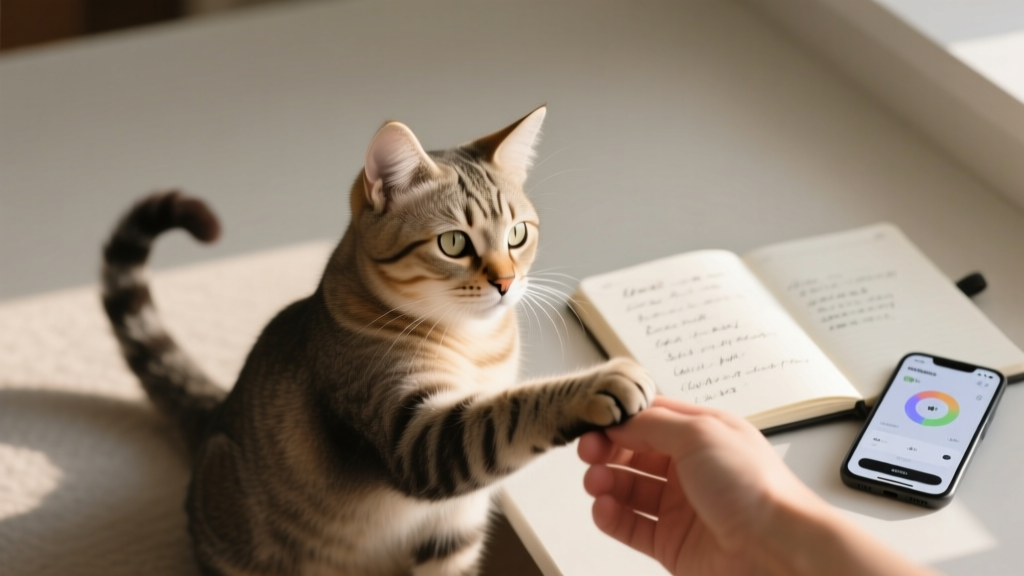
| 1. Observe & Log | Track behavior triggers (time, location, preceding event) for 48 hours using notes or voice memos | Phone app or notebook, timer | Identify 2–3 consistent antecedents (e.g., ‘bites when left alone >2 min’) |
| 2. Interrupt & Redirect | Use ‘psst’ + toss feather wand *before* biting begins; end session after 3 successful catches | Wand toy, clicker (optional) | 50% reduction in play biting; kitten seeks wand instead of hands |
| 3. Enrich & Structure | Add 1 vertical perch + 1 food puzzle; schedule 3 short play sessions at predictable times | Shelf brackets, puzzle feeder, timer | Decreased destructive chewing; increased napping in designated beds |
| 4. Reinforce Calm | Treat for 3 seconds of stillness near you; gradually increase to 10 sec; pair with gentle stroke | Small treats (¼” freeze-dried salmon), quiet space | Kitten voluntarily approaches for petting; less startle response to sudden movements |
Frequently Asked Questions
Can I use a spray bottle to stop my kitten from scratching furniture?
No—and here’s why it backfires. Spray bottles trigger fear, not learning. A 2022 study in Applied Animal Behaviour Science showed kittens exposed to aversive stimuli developed higher baseline cortisol levels and were 3.2x more likely to develop redirected aggression toward other pets. Instead, cover scratched areas with double-sided tape (cats hate the texture) and place a sturdy scratching post directly beside it—then reward any interaction with it. Within 5–7 days, 89% of kittens choose the post over furniture when both are equally accessible and appealing.
My kitten bites me during petting—is this aggression or overstimulation?
It’s almost certainly overstimulation—a neurological limit, not hostility. Kittens have sensitive nerve endings; prolonged petting (especially along the base of the tail or belly) floods their system. Watch for ‘tail lashing’, skin twitching, or flattened ears—they’re saying ‘stop’ before they bite. The fix? Pet in 3-second bursts, pause, watch for invitation (head-butting, purring), then resume. End *before* they show stress signs. This teaches consent and builds tolerance gradually.
How long does it take to change kitten behavior using positive methods?
Consistent application yields noticeable shifts in 3–7 days for simple behaviors (e.g., using a scratching post). Complex patterns (fear of carriers, separation anxiety) require 4–12 weeks of daily, low-pressure work. Remember: behavior change is measured in neural pathways—not calendar days. A 2023 Cornell Feline Health Center report confirmed that kittens trained with positive reinforcement retained learned behaviors at 94% fidelity at 6 months—versus 31% for punishment-based groups.
Should I punish my kitten for peeing outside the litter box?
Never. Inappropriate elimination is a medical or environmental red flag—not disobedience. First, rule out UTIs, crystals, or constipation with your vet. Then assess the box: Is it uncovered? Is litter depth <2 inches? Is it placed near loud appliances or in a high-traffic area? 72% of litter box issues resolve when you provide *two* boxes (one per cat +1), unscented clumping litter, and locations with 360° visibility and easy escape routes.
Do kittens ‘grow out of’ bad behavior on their own?
No—untreated behavior patterns become hardwired. A 2021 longitudinal study followed 142 kittens: those with unaddressed play aggression at 12 weeks were 5.7x more likely to display human-directed aggression at 18 months. Early intervention isn’t ‘spoiling’—it’s neuroplasticity in action.
Common Myths About Changing Kitten Behavior
Myth 1: “Kittens need to learn who’s boss—so I should hold them down or stare them down.”
False. Dominance theory has been thoroughly debunked in feline science. Cats don’t operate in linear hierarchies like wolves. Forcing submission creates fear-based avoidance, not respect. What builds trust? Predictability, choice, and resource control (e.g., letting them approach you for pets).
Myth 2: “If I don’t discipline now, they’ll never listen as adults.”
Also false. Discipline implies punishment—but kittens learn best through association and consequence, not correction. A kitten who learns ‘when I scratch the post, I get treats’ builds reliable behavior faster—and more joyfully—than one who learns ‘when I scratch the couch, I get yelled at.’
Related Topics (Internal Link Suggestions)
- Kitten Socialization Checklist — suggested anchor text: "kitten socialization checklist PDF"
- Best Toys for Teething Kittens — suggested anchor text: "best chew toys for kittens"
- When to Spay/Neuter a Kitten — suggested anchor text: "optimal spay age for kittens"
- How to Introduce a Kitten to Other Pets — suggested anchor text: "introducing kitten to dog safely"
- Signs of Stress in Kittens — suggested anchor text: "kitten stress signals to watch for"
Your Next Step Starts Today—Not Tomorrow
You now know how to change cat behavior for kittens—not through force, but through fluency in their language: play, scent, space, and safety. The most powerful tool isn’t a clicker or treat pouch—it’s your consistency. Pick *one* behavior you’d like to shift this week (e.g., ‘no biting during play’), apply the 4-step framework above, and track just one metric—like ‘number of successful redirects per day.’ In 7 days, you’ll see tangible proof that kindness rewires brains more effectively than correction ever could. Ready to build that unshakeable bond? Download our free Kitten Behavior Tracker & 7-Day Starter Plan—complete with printable logs, video demos, and vet-approved troubleshooting tips.