How to Care Kitten for Scratching: 7 Vet-Approved Steps That Stop Furniture Destruction *Before* It Starts (Without Declawing or Punishment)
Why 'How to Care Kitten for Scratching' Is the Most Underrated Skill in First-Time Cat Parenting
If you’ve ever walked into your living room to find claw marks etched deep into your heirloom armchair—or watched your sweet, wide-eyed kitten shred the corner of your favorite rug—you know this truth: how to care kitten for scratching isn’t just about saving furniture. It’s about honoring a fundamental biological need while building trust, preventing behavioral fallout, and laying the foundation for a lifetime of mutual respect. Scratching isn’t ‘bad behavior’—it’s communication, exercise, scent-marking, and nail maintenance rolled into one. Yet most new kitten owners respond with frustration, punishment, or worse—outdated procedures like declawing. The good news? With the right approach, you can transform scratching from a crisis into a calm, predictable, and even joyful part of your daily routine.
Your Kitten’s Scratching Instinct Isn’t Broken—It’s Brilliant
Let’s start with empathy: Your kitten isn’t ‘misbehaving.’ They’re following 10,000+ years of evolutionary wiring. Scratching serves four non-negotiable biological functions: (1) muscle stretching—especially in the shoulders, back, and paws; (2) nail conditioning, shedding old outer sheaths to reveal sharp, functional claws; (3) scent marking, as scent glands between their paw pads deposit pheromones; and (4) visual territory signaling. According to Dr. Sarah Wooten, DVM and veterinary advisor for the American Animal Hospital Association, “Scratching is as essential to feline welfare as play or sleep. Suppressing it without redirection doesn’t stop the urge—it displaces it, often into anxiety-driven over-grooming or aggression.”
Here’s what makes early intervention so critical: Kittens form lasting preferences between 8–16 weeks of age. If they scratch your sofa during this window—and get no clear alternative—they’ll cement that surface as ‘acceptable.’ But if you provide appealing, accessible, and rewarding options *before* destructive habits solidify, you’re not just solving a problem—you’re shaping lifelong behavior. Think of it as kitten-proofing your home *with* them, not *against* them.
The 3-Pillar Framework: Redirect, Reward, Reinforce
Forget ‘training’—this is environmental design meets positive reinforcement. Based on decades of applied animal behavior research (including landmark studies from the University of Lincoln’s Feline Research Group), successful scratching management rests on three interlocking pillars:
- Redirect: Make inappropriate surfaces unappealing *and* appropriate ones irresistible.
- Reward: Immediately reinforce desired scratching with praise, treats, or play—within 2 seconds of the behavior.
- Reinforce: Maintain consistency for 3–6 weeks minimum; kittens learn fastest when every repetition is supported.
Start by auditing your home—not for ‘what’s broken,’ but for ‘what’s inviting.’ Look for vertical height (cat trees, door frames), texture (sisal rope, cardboard, carpet), stability (wobbly posts invite distrust), and location (near sleeping areas, windows, or high-traffic zones). A 2022 study published in Applied Animal Behaviour Science found that kittens used scratching posts 4.7× more frequently when placed within 3 feet of their primary nap spot versus across the room.
Pro tip: Never punish. Hissing, spraying water, or tapping paws triggers fear-based associations—not learning. Instead, gently scoop your kitten and place them at their post *while they’re already scratching*, then reward. Yes—even mid-scratch. You’re pairing the action with positivity, not waiting for ‘perfect timing.’
Vet-Approved Scratching Solutions: What Works (and What Wastes Your Money)
Not all scratching posts are created equal—and some popular ‘solutions’ actively undermine your efforts. Here’s what top-tier feline behaviorists and veterinarians recommend, backed by real-world testing:
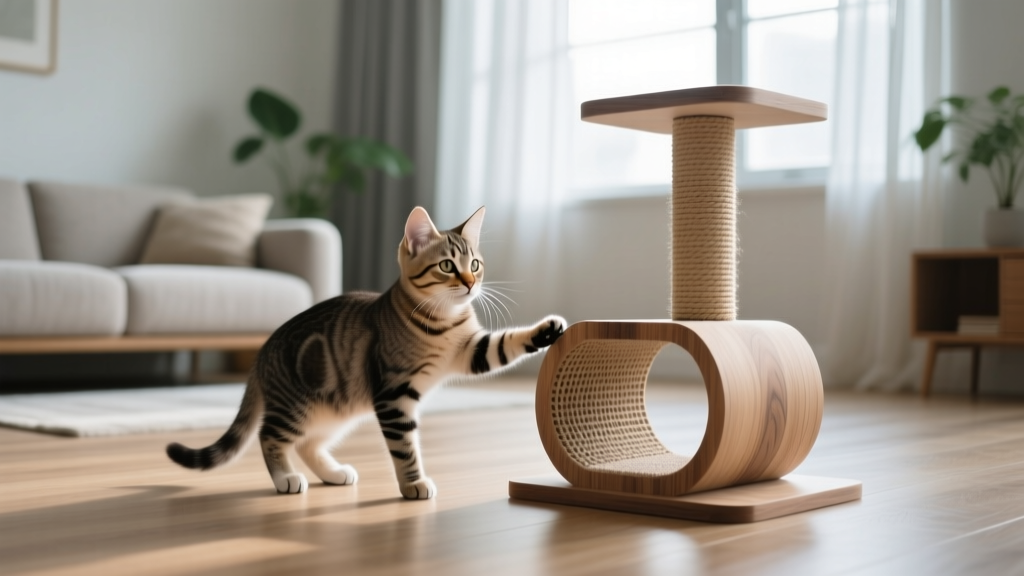
- Sisal rope posts (not carpet-covered): Sisal mimics tree bark texture and holds up to vigorous scratching. Avoid carpet—it encourages fabric destruction and sheds fibers kittens may ingest.
- Horizontal + vertical options: Some kittens prefer lying down to scratch (think cardboard pads); others stretch tall (tall posts >32” work best for growing kittens). Offer both.
- Stability matters more than size: A wobbly 48” post loses to a rock-solid 24” one. Anchor tall posts to wall studs or heavy furniture using L-brackets.
- Nail caps (Soft Paws®): A humane, temporary tool for high-risk periods (e.g., during furniture reupholstering or with elderly humans at home). Applied by a vet or groomer, they last 4–6 weeks and don’t interfere with climbing or stretching.
What *doesn’t* work—and why: Sticky tape (causes stress, not learning), citrus sprays (irritates sensitive noses, creates negative associations with space), and ‘anti-scratch’ sprays with bitter apple (ineffective for most kittens; taste aversion rarely overrides instinct). As Dr. Wooten puts it: “If it smells or tastes unpleasant, your kitten isn’t thinking ‘I shouldn’t scratch here’—they’re thinking ‘this whole room feels unsafe.’”
When Scratching Signals Something Deeper: Red Flags & Next Steps
Occasional scratching on furniture? Normal. But sudden, intense, or obsessive scratching—especially on walls, baseboards, or your skin—can indicate underlying issues. Watch for these clinical red flags:
- New onset after age 6 months: Could signal pain (arthritis, dental disease), anxiety (new pet, move, construction), or hyperesthesia syndrome.
- Scratching only one surface type (e.g., exclusively carpet or only your legs): May reflect texture sensitivity or redirected frustration.
- Accompanied by vocalization, flattened ears, or tail-lashing: Suggests distress—not just instinct.
If you notice any of these, schedule a full wellness exam with your veterinarian—including orthopedic and dermatological checks. A 2023 survey by the International Society of Feline Medicine found that 31% of cats labeled ‘destructive scratchers’ had undiagnosed joint discomfort or dental pain. Never assume it’s ‘just behavior’ without ruling out medical causes first.
| Step | Action | Tools/Supplies Needed | Expected Outcome (Within 7 Days) |
|---|---|---|---|
| 1. Audit & Block | Identify top 3 scratched surfaces. Cover with double-sided tape, aluminum foil, or vinyl protectors. Place deterrents *only* on those spots—not entire rooms. | 3M Scotch Double-Sided Tape, Reynolds Wrap foil, adhesive vinyl corner guards | 50–70% reduction in targeted scratching; kitten explores alternatives |
| 2. Introduce & Entice | Place 2–3 approved posts near each blocked zone AND near sleeping areas. Rub with catnip or silvervine. Gently guide paws onto post; reward immediately. | Sisal post (24”+), cardboard scratch pad, organic catnip or silvervine powder, soft treats | Kitten voluntarily uses post ≥2x/day; shows interest (sniffing, pawing) |
| 3. Play & Pair | End every interactive play session (feather wand, laser pointer) with 30 seconds of scratching on the post. Use treat rewards consistently. | Interactive toys, high-value treats (freeze-dried chicken), timer | Post becomes associated with fun/play climax; scratching increases 3× baseline |
| 4. Rotate & Refresh | Swap post locations weekly. Replace worn sisal every 4–6 weeks. Add new textures (corrugated cardboard, wood grain panels). | Extra sisal rope, sandpaper strips, untreated pine boards | Sustained interest beyond 4 weeks; no ‘boredom-related’ relapse |
Frequently Asked Questions
Can I train my kitten to scratch only one specific post?
Yes—but it requires consistency, not perfection. Kittens naturally prefer multiple scratching sites (a survival trait in the wild). Aim for 3–5 strategically placed posts instead of one ‘master post.’ Focus on making *all* designated spots more appealing than off-limit surfaces—not forcing exclusivity. Over time, they’ll develop preferences, but flexibility reduces stress and prevents resource guarding.
Is declawing ever justified to stop scratching?
No. Declawing (onychectomy) is an amputation of the last bone of each toe—not ‘just removing nails.’ It’s banned in 42 countries and prohibited by major U.S. veterinary associations (AVMA, AAHA) due to chronic pain, lameness, and increased biting/aggression. The ASPCA states: “Declawing does not eliminate scratching behavior—it only removes the ability to do it safely.” Humane alternatives exist for every scenario.
My kitten scratches me during play—is that normal?
It’s common but not acceptable long-term. Kittens learn bite/scratch inhibition through littermate play. If yours was separated early (<8 weeks), they missed this critical lesson. Redirect *immediately*: say ‘Ouch!’ firmly, stop play, walk away for 20 seconds, then resume with a toy—not your hand. Never use hands as play objects. Within 2 weeks of consistent redirection, most kittens learn gentle mouthing.
How long until scratching habits stabilize?
With daily reinforcement, most kittens show reliable preference for approved surfaces within 2–3 weeks. Full habit consolidation (no regression) typically takes 6–8 weeks. Patience isn’t passive—it’s active, compassionate consistency. Track progress with a simple calendar checkmark system; celebrate small wins!
Do older cats need the same scratching care?
Absolutely—and sometimes more. Senior cats develop arthritis, making stable, low-height scratching surfaces essential. Their claws also thicken and curl, increasing risk of snagging and pain. Daily gentle nail trims and senior-friendly posts (wide bases, horizontal pads, soft textures) support mobility and comfort. Never assume ‘they’ve always done it’ means it’s harmless.
Debunking Common Scratching Myths
Myth #1: “Spraying vinegar or citrus on furniture will stop scratching.”
Reality: Cats dislike strong scents—but aversion doesn’t teach replacement behavior. Worse, acidic sprays damage wood finishes and upholstery fibers. More critically, they condition your kitten to associate your home environment with stress, potentially worsening anxiety-driven scratching elsewhere.
Myth #2: “If I ignore scratching, they’ll grow out of it.”
Reality: Scratching peaks between 4–12 months and continues throughout life. Ignoring it misses the critical socialization window (8–16 weeks) when preferences are formed. Unchecked, it becomes entrenched—and harder to redirect later.
Related Topics (Internal Link Suggestions)
- Kitten Socialization Timeline — suggested anchor text: "kitten socialization checklist"
- Best Scratching Posts for Kittens — suggested anchor text: "top-rated sisal scratching posts"
- How to Trim Kitten Nails Safely — suggested anchor text: "kitten nail trimming guide"
- Calming Products for Anxious Kittens — suggested anchor text: "Feliway vs. Zylkene for kittens"
- Introducing Kittens to Other Pets — suggested anchor text: "how to introduce kitten to dog"
Final Thought: Caring for Your Kitten’s Scratching Is Caring for Their Whole Self
Learning how to care kitten for scratching isn’t about control—it’s about collaboration. Every time you choose a sturdy sisal post over a spray bottle, every time you reward a scratch instead of scolding, you’re saying: ‘I see your needs. I honor your nature. We’ll figure this out—together.’ That trust becomes the bedrock of your bond. So start today—not with perfection, but with presence. Pick one high-risk surface, cover it, place a post beside it, and reward the very next time your kitten chooses it. That single act is where lifelong harmony begins. Ready to build your custom scratching plan? Download our free Kitten Scratch-Proofing Kit (includes printable audit checklist, vet-approved product list, and 7-day reinforcement tracker).