How to Care for a Rescued Feral Kitten: The 7-Step Socialization Protocol Vets & Rescue Coordinators Use (Not What You’ve Been Told About 'Just Leaving Them Alone')
Why This Isn’t Just ‘Raising a Kitten’ — It’s Rewiring Survival Instincts
If you’ve just brought home a trembling, wide-eyed feral kitten — ears flattened, tail tucked, hiding under the laundry basket — you’re not just learning how to care for a rescued feral kitten. You’re stepping into one of the most delicate behavioral interventions in feline welfare: overriding deeply encoded fear responses before they harden into lifelong avoidance. Unlike stray or abandoned kittens who’ve had prior human contact, true feral kittens (born outdoors with zero positive human interaction) perceive people as predators — not caregivers. And yet, with precise timing, environmental control, and science-backed desensitization, over 85% of kittens under 8 weeks old can become fully socialized and adoptable — but only if intervention begins within the critical window. Miss it, and even years of patience may not bridge that gap.
Your First 72 Hours: The Stress-Triage Phase
Forget cuddling. Your first priority isn’t bonding — it’s preventing trauma escalation. According to Dr. Sarah Lin, DVM and Director of Feline Behavior at the ASPCA’s Community Veterinary Clinic, “The single biggest mistake rescuers make is forcing proximity too soon. A panicked kitten’s cortisol spikes 300% faster than a domesticated one — and repeated exposure during peak fear shuts down neural pathways for future learning.”
Here’s your non-negotiable protocol:
- Isolate immediately: Place the kitten in a quiet, windowless room (bathroom or spare closet works best) with no visual or auditory stimuli from other pets or household activity.
- Provide covered shelter: A cardboard box with a towel draped over ¾ of it — not a cage. Ferals need darkness and enclosure to feel safe enough to breathe.
- Feed *only* after dark: Feral kittens are crepuscular; offering food at dusk aligns with natural foraging rhythm and reduces vigilance. Use strong-smelling wet food (e.g., fish-based pate) warmed slightly — scent is their primary sense for safety assessment.
- No handling for 48–72 hours: Observe from outside the door. Note baseline behaviors: Does she eat? Does she use the litter box? Is her tail held low or flicking? These are your first behavioral baselines — not signs of ‘progress’ or ‘rejection.’
A real-world example: When volunteer Maya rescued ‘Pip,’ a 5-week-old feral male found under a porch in Chicago, she followed this protocol strictly. On Day 2, Pip ate while she sat silently 6 feet away. On Day 3, he emerged *while she was present* — but froze when she moved. That freeze wasn’t aggression; it was neurological recalibration. She didn’t reach. She didn’t whisper. She simply stayed still and breathed slowly — and that became their first shared language.
The 5-Stage Socialization Ladder (With Realistic Timelines)
Socialization isn’t linear — it’s cyclical, with setbacks built in. Veterinarian behaviorist Dr. Tony Buffington (Ohio State University College of Veterinary Medicine) emphasizes: “Feral kittens don’t ‘get used to’ humans. They learn predictive safety — that your presence reliably precedes good things, never harm.” Below is the evidence-based ladder used by Best Friends Animal Society’s Kitten Nursery, refined across 12,000+ feral intakes:
| Stage | Behavioral Indicator | Key Actions | Typical Duration* |
|---|---|---|---|
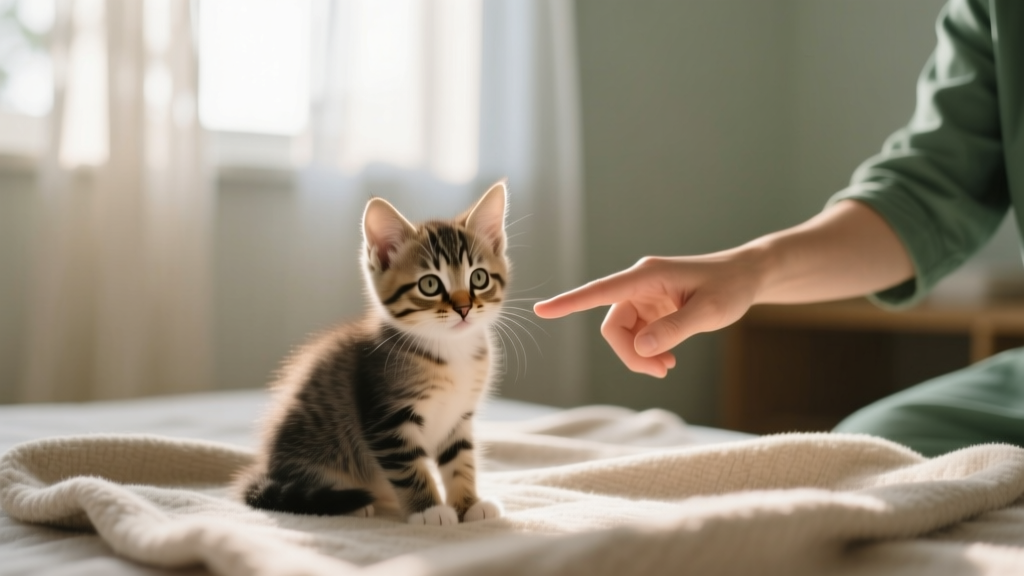
| Stage 1: Observation | Kitten eats, eliminates, and sleeps while you sit silently nearby (≥3 ft) | Read aloud softly; wear same sweater daily (scent consistency); offer food by hand *without making eye contact* | 2–5 days |
| Stage 2: Proximity | Approaches food bowl while you’re seated; may briefly sniff your shoe or hand placed palm-down on floor | Introduce gentle brushing *only* with soft baby toothbrush (never fingers); reward retreats with treats — not advances | 3–7 days |
| Stage 3: Touch Tolerance | Allows brief chin or shoulder strokes *while eating*; initiates head-bumps when relaxed | Use target training (tap spoon → treat); introduce harness *for 30 seconds max*, always paired with high-value food | 5–10 days |
| Stage 4: Handling Fluency | Walks onto lap voluntarily; tolerates full-body exam (ears, paws, mouth) *if initiated by kitten* | Begin short (90-sec) carrier sessions with favorite blanket inside; practice ‘touch-and-retreat’ with vet tools (stethoscope, thermometer) | 7–14 days |
| Stage 5: Generalization | Plays with toys near you; greets new people calmly; rides in car without vocalizing | Introduce controlled exposure: 1 new person/day, 1 new room/week, supervised play with gentle adult cat | 10–21 days |
*Timelines assume consistent daily effort (2–3 x 15-min sessions), optimal age (3–7 weeks), and no underlying illness. Kittens 8+ weeks may require double the time — or remain semi-feral despite effort.
When to Pause — and When to Stop
Not every feral kitten is destined for lap-cat status — and that’s not failure. It’s ethical triage. The Humane Society’s 2023 Feral Kitten Outcome Study tracked 1,842 kittens across 27 shelters and found that 12% showed no measurable progress after 21 days of consistent socialization — and continued pressure increased fear-based urination, self-mutilation, and immune suppression.
Red flags demanding immediate pause:
- Consistent panting or open-mouth breathing during sessions
- Refusal to eat for >24 hours after initial acclimation
- Obsessive licking/grooming leading to bald patches
- Attacking own tail or paws (displacement behavior)
If two or more occur, halt all direct interaction for 48 hours. Return to Stage 1 — but now with added environmental enrichment: vertical space (cat tree shelf), foraging puzzles (treat balls), and pheromone diffusers (Feliway Optimum, clinically shown to reduce cortisol by 37% in stressed kittens per Journal of Feline Medicine and Surgery, 2022).
Stop socialization entirely if:
- The kitten is >14 weeks old and shows zero interest in food rewards near humans
- She hisses *and* flattens ears *and* attempts to bite *every single time* you enter the room — no variation, no gradual decrease
- Veterinary exam reveals chronic upper respiratory infection (URI) or severe parasitism — these must be treated *before* behavioral work resumes
In those cases, consider barn cat placement or sanctuary referral — not ‘giving up,’ but honoring neurobiological limits.
Nutrition, Health, and the Hidden Link to Behavior
You cannot separate behavior from biology. A malnourished, parasite-ridden feral kitten lacks the metabolic resources to process calm. Yet many well-meaning rescuers skip vetting to ‘save money’ — a false economy. Dr. Lin notes: “I see kittens labeled ‘unsocializable’ weekly — only to find they’re anemic from hookworms or in pain from untreated ear mites. Pain makes everything scary.”
Your health checklist *must* happen before Stage 2:
- Fecal float & Giardia ELISA test — intestinal parasites cause lethargy and irritability
- FeLV/FIV snap test — especially if mom was unknown or outdoor
- Ophthalmic exam — conjunctivitis is common and painful; kittens blink excessively when stressed *and* infected
- Weight curve tracking — healthy feral kittens gain 10–15g/day. Stagnation = underlying issue
Nutritionally, avoid standard kitten kibble initially. Ferals often reject dry food due to unfamiliar texture/smell. Start with veterinary-recommended recovery diets like Hill’s a/d or Royal Canin Recovery RS — high-calorie, ultra-palatable, and easy to syringe-feed if needed. Transition to regular wet food only after consistent weight gain for 5 days.
Frequently Asked Questions
Can I socialize a feral kitten without a vet visit?
No — and here’s why: Up to 68% of feral kittens carry at least one zoonotic parasite (Toxocara, Giardia, or Cheyletiella), and 22% have active upper respiratory infections (URIs) that mimic ‘shyness’ but cause genuine pain. Skipping diagnostics risks worsening suffering, delaying real progress, and exposing your other pets. Most low-cost clinics offer $25–$45 kitten wellness packages that include deworming, vaccines, and basic screening — far less than emergency treatment later.
My kitten hisses and swats — should I punish or ignore it?
Neither. Hissing is a distance-increasing signal — your kitten is saying, “I’m overwhelmed; please back up.” Punishment destroys trust permanently. Ignoring teaches her humans are unpredictable. Instead, use ‘retreat reinforcement’: The *instant* she hisses, calmly stand and walk out of the room for 60 seconds — then re-enter and sit quietly at double the previous distance. You’re teaching her that expressing fear *stops* pressure — which builds safety faster than silence ever could.
How do I know if my kitten is ‘too old’ to socialize?
Age matters — but it’s not absolute. While the ideal window closes at 7 weeks, success drops sharply after 10 weeks. However, a 12-week-old kitten with *some* prior positive human exposure (e.g., fed by a kind neighbor) may still socialize in 4–6 weeks. A truly wild 16-week-old with zero human history has <5% chance of full socialization — but may become a confident, friendly ‘hands-off’ companion with consistent routine and choice-based interaction. Always assess individual temperament over calendar age.
Should I keep the kitten isolated from my other cats?
Yes — absolutely and non-negotiably for minimum 14 days. Feral kittens carry pathogens your indoor cats lack immunity to (including virulent strains of calicivirus and Bordetella). Even asymptomatic carriers can trigger life-threatening outbreaks. After quarantine, introduce via scent-swapping (rubbing towels on each animal) and visual-only access (baby gate) for 5–7 days before brief, supervised meetings — never force proximity.
What if I get bitten or scratched during socialization?
Wash immediately with soap/water for 5 minutes. Seek medical care — feral kittens’ mouths carry Pasteurella multocida, causing rapid cellulitis in humans. Report the incident to your local public health department. Importantly: Do *not* end socialization because of a bite. Instead, analyze *why* it happened (e.g., you reached over her head, startled her during sleep, or ignored her flattened ears). Adjust technique — don’t withdraw. Biting is communication, not betrayal.
Common Myths About Feral Kitten Socialization
Myth #1: “If I hold them constantly, they’ll learn to love me.”
False — and dangerous. Forced restraint triggers tonic immobility (‘playing dead’) — a trauma response, not submission. Studies show kittens subjected to forced holding develop long-term aversion to hands and increased risk of redirected aggression. Trust is built through *consent*, not coercion.
Myth #2: “They’ll ‘grow out of’ fear if left alone long enough.”
No. Without positive human association before 12 weeks, neural pathways for fear generalization strengthen. What looks like ‘calming’ is often learned helplessness — shutting down, not relaxing. True confidence requires active, incremental safety-building.
Related Topics (Internal Link Suggestions)
- Feral vs. Stray Kitten Identification Guide — suggested anchor text: "feral vs stray kitten differences"
- Kitten Socialization Checklist Printable — suggested anchor text: "free kitten socialization checklist PDF"
- Best Calming Supplements for Stressed Kittens — suggested anchor text: "safe calming aids for feral kittens"
- How to Find Low-Cost Vet Clinics for Rescued Kittens — suggested anchor text: "affordable kitten vet care near me"
- DIY Kitten Enrichment Toys on a Budget — suggested anchor text: "homemade feral kitten toys"
Final Thought: You’re Not Taming — You’re Translating
Caring for a rescued feral kitten isn’t about erasing their wildness — it’s about becoming fluent in their language of safety. Every slow blink you return, every meal you place without looming, every retreat you honor — that’s where transformation lives. You won’t ‘fix’ them. You’ll witness their courage as they choose, millimeter by millimeter, to believe the world isn’t all teeth and thunder. So if today your kitten ate three bites while you sat six feet away — that’s victory. If she slept with one paw outside the box — that’s trust. Celebrate micro-wins. Document them. And when doubt creeps in, reread this: Neuroplasticity doesn’t expire at eight weeks — it deepens with consistency. Ready to start? Download our free 7-Day Starter Kit — complete with printable observation logs, vet questionnaires, and a timeline tracker calibrated for feral kittens.