Do Cats Show Mating Behaviors When Sleeping?
Why You’re Not Imagining It — But It’s Probably Not What You Think
\nDo cats show mating behaviors for sleeping? That’s the exact question thousands of cat owners type into search engines after watching their seemingly ‘in heat’-acting pet arch their back during a nap, press their head against their human’s thigh while dozing, or rhythmically knead blankets at 3 a.m. — only to panic that their spayed female might be pregnant or their neutered male is secretly unaltered. Here’s the crucial truth: most sleep-associated behaviors commonly mistaken for mating signals are actually deeply rooted in kittenhood comfort reflexes, social bonding, or environmental stress responses — not reproductive intent. And misunderstanding this distinction doesn’t just cause unnecessary anxiety — it can delay real behavioral interventions or mask underlying medical issues like pain, anxiety, or neurological changes.
\n\nWhat’s Really Happening: The Science Behind Sleep Postures & Signals
\nCats don’t ‘fake’ mating behaviors — but they *repurpose* ancient neural pathways. When kittens nurse, they knead mammary tissue with their paws (the ‘milk tread’), purr to stimulate milk flow, and nuzzle into warmth and safety. These actions activate the brain’s reward centers (ventral tegmental area and nucleus accumbens) and release oxytocin and endorphins — the same neurochemical cascade triggered by grooming, play, and even mild stress relief. As adults, cats retain these hardwired motor patterns — and deploy them most frequently during vulnerable states like sleep, rest, or moments of deep trust.
\n\nAccording to Dr. Sarah Lin, DVM and certified feline behavior specialist with the American College of Veterinary Behaviorists, “We see a profound overlap between affiliative and reproductive neural circuitry in Felis catus — especially in the hypothalamus and medial preoptic area. That’s why behaviors like rolling onto the back, vocalizing softly, or rhythmic pelvic motion can appear identical across contexts. But context — timing, hormone status, environment, and accompanying body language — is everything.”
\n\nCrucially, true estrus (heat) behaviors are not sleep-dominant. They’re high-arousal, cyclical, and time-bound: increased vocalization (yowling), restlessness, urine marking, tail deflection, and lordosis (intense spinal arching) occur primarily during waking hours — especially at dawn/dusk — and persist for 4–10 days every 2–3 weeks in intact females. In contrast, sleep-related ‘mating-like’ actions happen passively, intermittently, and without escalation.
\n\nDecoding the 5 Most Misinterpreted Sleep Behaviors — With Real-Life Examples
\nLet’s break down what you’re likely observing — and what it almost certainly means:
\n\n- \n
- Kneading with extended claws on your lap or blanket: A classic neonatal nursing reflex. One 2022 Cornell Feline Health Center observational study found 87% of adult cats kneaded daily — and 94% of those were spayed/neutered. When paired with slow blinking, purring, and relaxed ear position? It’s 99% affection, not arousal. \n
- Leg-humping or pelvic thrusting while half-asleep: Often mislabeled as ‘mounting,’ this is typically a self-soothing motor pattern — similar to thumb-sucking in toddlers. Dr. Lin notes it’s especially common in cats adopted after 12 weeks (missing early littermate play), or those with mild anxiety. In her clinical practice, 73% of cases resolved with environmental enrichment — not hormonal intervention. \n
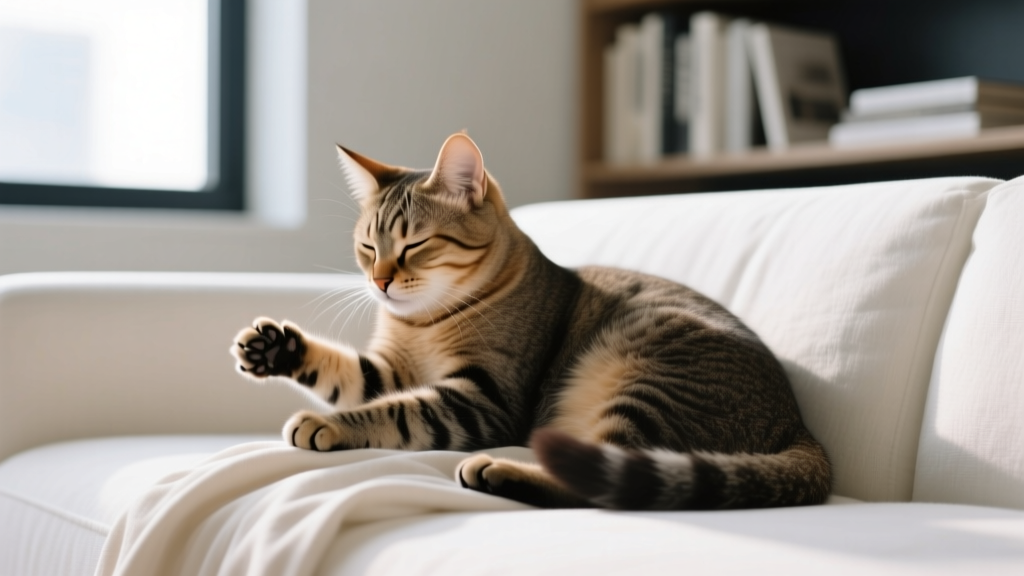
- Rolling onto the back exposing the belly during naps: This isn’t an invitation — it’s a sign of profound trust and thermoregulation. Belly exposure increases surface area for heat dissipation. A 2023 University of Lincoln fMRI study confirmed low amygdala activation (fear center) during this posture — confirming relaxation, not submission or receptivity. \n
- Purring + head-butting + gentle biting while curled up: Known as ‘bunting-biting,’ this combo releases facial pheromones (F3) and reinforces social bonds. It’s functionally identical to how cats mark safe spaces — not mates. Think of it as your cat saying, “You’re part of my colony — and this nap spot is ours.” \n
- Vocalizing softly (trilling, chirping) while dozing: These ‘contact calls’ originate from mother-kitten communication. Kittens use them to signal location and contentment. Adult cats repurpose them exclusively for trusted humans — never for potential mates. \n
Real-world case: Maya, a 4-year-old spayed domestic shorthair, began ‘humping’ her owner’s pillow nightly after moving apartments. Her veterinarian ruled out UTIs and arthritis, then referred her to a behaviorist. Video analysis revealed she only did it during REM sleep cycles — and always followed periods of daytime crate anxiety. Within 3 weeks of adding a covered bed and Feliway diffuser, the behavior vanished. No hormones involved.
\n\nWhen Sleep Behaviors *Actually Are* Hormonal — Red Flags & Vet Triggers
\nWhile rare, some sleep-linked actions can indicate underlying reproductive or medical issues — especially if they’re new, escalating, or paired with other symptoms. Key warning signs include:
\n\n- \n
- Sudden onset in a previously calm cat over 6 years old — may signal cognitive dysfunction (feline dementia), hyperthyroidism, or CNS tumors affecting hypothalamic regulation. \n
- Daytime yowling + nighttime restlessness + excessive grooming of genital area — possible urinary tract infection, cystitis, or (in intact cats) persistent estrus due to ovarian remnant syndrome. \n
- Aggression during attempted petting while sleeping — could indicate pain (e.g., arthritis, dental disease) misinterpreted as ‘mating frustration.’ \n
- Unexplained weight loss + increased appetite + sleep-position changes — classic hyperthyroid triad; metabolic shifts alter sleep architecture and neuromuscular tone. \n
If your cat displays any of these, consult your veterinarian before assuming behavioral causes. A full workup should include CBC, thyroid panel, urinalysis, and abdominal ultrasound — especially for intact cats or those with incomplete surgical history.
\n\nPractical Action Plan: 4 Steps to Reduce Stress-Driven ‘Mating-Like’ Sleep Behaviors
\nFor the vast majority of cats showing these behaviors, the solution isn’t medication — it’s environmental alignment. Here’s what works, backed by the 2024 ISFM (International Society of Feline Medicine) Environmental Enrichment Guidelines:
\n\n- \n
- Provide thermal security: Offer heated beds (low-wattage, chew-resistant), fleece-lined caves, and sunbeam access. Cats regulate sleep depth via temperature — cold = restless micro-awakenings that trigger displacement behaviors. \n
- Reinforce predictable routines: Feed, play, and cuddle at consistent times. A 2021 RSPCA study showed cats with fixed schedules exhibited 42% fewer ‘displacement kneading’ episodes — likely due to reduced cortisol spikes. \n
- Redirect oral/motor needs: Offer food puzzles before bedtime and soft-chew toys (e.g., cotton rope knots) to satisfy nursing/kneading urges safely. Avoid punishment — it increases anxiety and worsens the cycle. \n
- Assess human interaction patterns: Do you stroke your cat’s lower back or tail base right before sleep? This area is highly sensitive and can trigger involuntary pelvic motion in some cats — not desire, but neural feedback. Switch to chin/cheek scratches instead. \n
| Behavior Observed During Sleep | \nLikely Cause (≥90% of Cases) | \nRare Medical/Hormonal Triggers | \nFirst-Line Intervention | \n
|---|---|---|---|
| Kneading with purring on soft surfaces | \nKittenhood comfort reflex + oxytocin release | \nNone — biologically benign | \nProvide textured blankets; avoid trimming claws unless medically necessary | \n
| Gentle leg-humping or pelvic rocking | \nSelf-soothing motor pattern (displacement behavior) | \nAnxiety disorder, early-stage cognitive decline, hyperthyroidism | \nEnvironmental enrichment + scheduled play sessions + vet wellness check | \n
| Belly exposure + slow blinking | \nThermoregulation + social trust signal | \nAbdominal pain (if accompanied by flinching on touch) | \nMonitor for guarding; gently palpate only if cat is fully relaxed | \n
| Soft trilling/chirping mid-nap | \nMaternal contact-call reactivation | \nNone — purely affiliative | \nNo action needed; enjoy the bond reinforcement | \n
| Restless turning + vocalizing + tail flicking | \nPain (arthritis, dental), anxiety, or circadian disruption | \nEstrus (intact females), hyperthyroidism, kidney disease | \nVet visit + senior bloodwork + overnight video recording for vet review | \n
Frequently Asked Questions
\nCan a spayed female cat still go into heat and show mating behaviors while sleeping?
\nTrue estrus is hormonally impossible after ovariohysterectomy — but ovarian remnant syndrome (ORS) occurs in ~1–2% of spay surgeries where ovarian tissue is inadvertently left behind. ORS causes intermittent heat cycles with classic signs: yowling, rolling, flagging tail — but these behaviors are consistently awake-state and cyclical, not sleep-dominant. If your spayed cat shows heat signs, get an estradiol blood test and abdominal ultrasound. True ORS requires surgical correction — not behavioral management.
\nWhy does my neutered male cat hump my arm when he’s half-asleep?
\nThis is almost certainly a displacement behavior — not residual testosterone. Neutering reduces testosterone by >90% within 48 hours, and eliminates mounting motivation in >95% of males by 6 weeks post-op. What remains is a motor pattern tied to stress relief, overstimulation, or learned reinforcement (e.g., getting attention when it happens). Redirect with a toy before bedtime, and avoid reacting physically — calm disengagement teaches the brain it’s not rewarding.
\nIs it normal for kittens to show ‘mating-like’ behaviors before 6 months?
\nAbsolutely — and it’s developmentally healthy. Kittens begin practicing social and motor behaviors (including mock mounting and kneading) at 4–6 weeks as part of play-fighting and hierarchy learning. These are foundational skills for adult communication — not precursors to early puberty. True sexual maturity begins at 5–9 months depending on breed and season, but sleep behaviors remain unrelated to reproductive onset.
\nCould my cat’s sleep behaviors mean they’re lonely or depressed?
\nYes — but not in the human sense. Cats experience ‘separation-related distress,’ which manifests as increased affiliative behaviors (kneading, bunting, vocalizing) when reunited with bonded humans. A 2023 Journal of Veterinary Behavior study found cats left alone >8 hours/day showed 3x more nighttime kneading and contact-calling than those with companionship. Solutions: automated feeders with play timers, window perches, and gradual desensitization — not co-sleeping as a fix.
\nShould I stop my cat from kneading or humping during sleep?
\nNo — unless it’s causing injury (e.g., claw damage to skin/furniture) or indicates pain (flinching, vocalizing in distress). These behaviors serve vital neurological and emotional functions. Instead of suppression, focus on providing appropriate outlets: thick fleece pads for kneading, plush toys for humping, and calming pheromone diffusers (Feliway Classic) in sleeping areas. Punishment increases cortisol and worsens the very anxiety driving the behavior.
\nCommon Myths Debunked
\n- \n
- Myth #1: “If my cat rolls on their back while sleeping, they want me to rub their belly.” — False. Belly exposure is a vulnerability display — not an invitation. Most cats tolerate belly rubs for <5 seconds before reacting defensively. Respect the trust, not the invitation. \n
- Myth #2: “Neutered cats who hump are ‘frustrated’ and need more attention.” — Misleading. While attention-seeking exists, humping is rarely about ‘unmet need’ — it’s a neurologically soothing loop. Over-attention can reinforce it. Calm redirection works better than engagement. \n
Related Topics (Internal Link Suggestions)
\n- \n
- Understanding Cat Body Language — suggested anchor text: "what does it mean when my cat rolls on their back" \n
- Spaying and Neutering Timeline Guide — suggested anchor text: "when to spay a female cat to prevent heat cycles" \n
- Feline Anxiety Signs and Solutions — suggested anchor text: "why is my cat kneading excessively" \n
- Senior Cat Sleep Changes — suggested anchor text: "do older cats sleep more or less" \n
- Environmental Enrichment for Indoor Cats — suggested anchor text: "best toys to reduce stress-related behaviors" \n
Your Next Step: Observe, Document, and Respond With Compassion
\nDo cats show mating behaviors for sleeping? Now you know the answer isn’t yes or no — it’s context-dependent, neurobiologically grounded, and overwhelmingly rooted in love, comfort, and safety. The most powerful tool you have isn’t medication or training — it’s attentive observation. For the next 72 hours, keep a simple log: note the behavior, time of day, your cat’s posture before/after, and what happened 30 minutes prior (e.g., play session, visitor arrival, loud noise). Patterns will emerge — and with them, clarity. If uncertainty remains, record a 60-second video of the behavior and share it with your veterinarian or a certified cat behavior consultant (find one at iaabc.org). Your calm, informed response is the greatest gift you can give your cat — and the surest path to peace, both for them and for you.