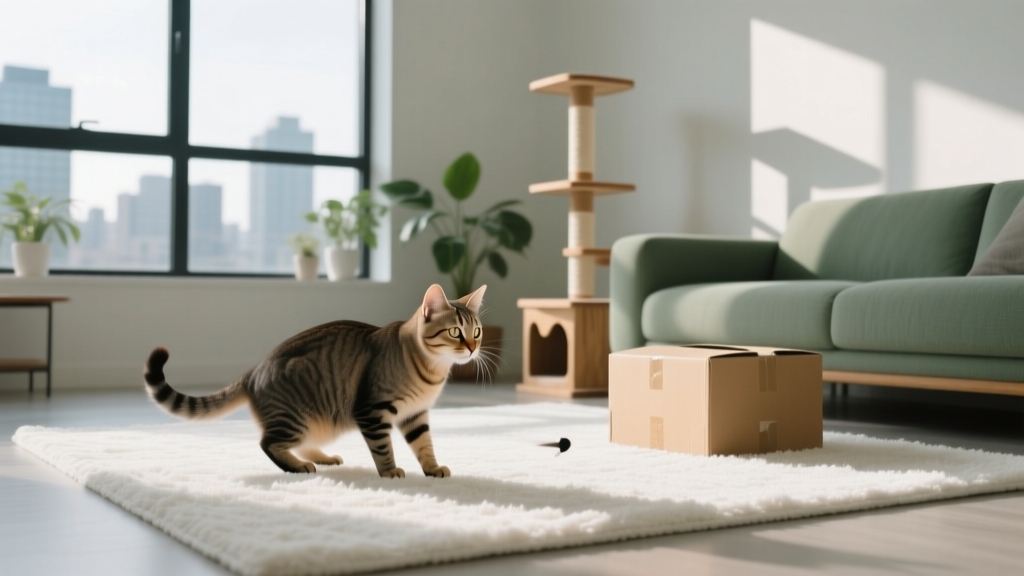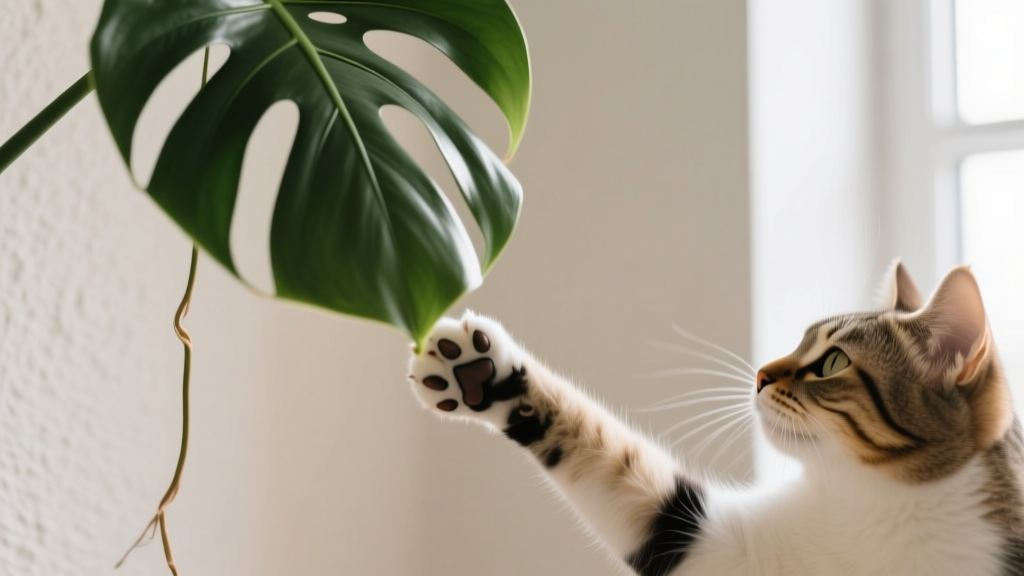
Cat Paw Swatting at Hanging Plant Leaves
You’re watering your pothos, minding your own business, when you hear it: the soft thwap-thwap of paws on leaves. You turn around and there’s your cat—sitting like a tiny jungle explorer—methodically swatting a dangling vine. The plant swings back. Your cat’s eyes go wide, pupils blooming into black saucers, and suddenly it’s a one-cat nature documentary in your living room.
If you’ve ever wondered why hanging plants are basically cat magnets (and why your cat looks so pleased with themselves while committing botanical chaos), you’re not alone. Paw-swats at dangling leaves are one of those perfectly “cat” behaviors: playful, strategic, a little mischievous, and rooted in instincts that go way deeper than your décor plans.
The scientific (and evolutionary) reason cats can’t resist swatting dangling leaves
Cats are wired to notice movement—especially movement that resembles prey. In the wild, small animals and insects often move in quick, irregular patterns: a flutter, a twitch, a sudden bounce. Hanging plant leaves, especially the long, thin ones, imitate that unpredictable motion beautifully. When a leaf shifts from airflow, watering, or a passing tail, it can look like something alive.
From an evolutionary perspective, cats are “opportunistic hunters.” Even well-fed indoor cats still carry the urge to stalk, pounce, bat, and pin. Those behaviors aren’t just about hunger—they’re about practicing skills that would keep them alive outdoors. Think of paw swatting as a low-stakes rehearsal: your cat gets to refine timing, coordination, and distance judgment without the pressure of a real hunt.
There’s also the “trigger” factor. Cats have a strong response to dangling objects because dangling equals catchable. Many prey items hang, flutter, or dangle in the environment: insects on stems, birds landing on thin branches, small lizards peeking from leaves. A suspended leaf offers the same kind of interactive challenge—bonus points because the leaf swings back when swatted, which keeps the game going.
A detailed breakdown: different contexts for plant-leaf swatting
Not all swats are created equal. The same behavior can mean slightly different things depending on the setup and your cat’s body language. Here are common scenarios cat owners recognize instantly.
1) The “drive-by bop” while walking past
Your cat strolls by a hanging plant and casually taps a leaf as if checking the day’s news. This is often light play and curiosity. It can also be a self-rewarding habit: one tap makes the leaf move, which makes the brain go, “Ah yes, I am powerful.”
2) The focused hunter: crouch, stare, swat, pounce
If your cat freezes, locks on with intense eyes, crouches low, and then launches into a series of rapid swats, you’re seeing predatory play. This is normal and healthy for many cats—especially younger cats or energetic adults who need more outlets.
3) The “wind-up and smack” with extra force
Some cats swat with dramatic gusto, sometimes to the point of knocking a hanging pot askew. This can still be play, but it’s often heightened arousal—your cat is extra excited, maybe even a bit overstimulated. You may see a twitchy tail, rippling back fur, or quick bursts of zoomies afterward.
4) The “taste-test” swat (swat… sniff… nibble)
Swatting can be the first step in exploring with the mouth. Cats investigate with their noses and lips, and many are drawn to the scent and texture of plants. Unfortunately, this is where “quirky” can become “concerning,” because many common houseplants are irritating or toxic. (More on that later.)
5) The attention-seeking performance
If your cat swats the plant while looking back at you or doing it only when you’re on a call, you may have an audience-aware comedian. Some cats learn that plant-bopping makes humans react—talking, approaching, or chasing them away—so the plant becomes a reliable “summon button.”
What this behavior says about your cat’s mood and feelings
Plant swatting is often a window into your cat’s emotional state. Here’s what to look for.
- Relaxed curiosity: Ears forward or neutral, soft eyes, gentle taps, slow sniffing. Your cat is exploring their environment and enjoying a little enrichment.
- Playful excitement: Dilated pupils, wiggly rear end, quick paw movements, bouncing on toes. Your cat is in “hunt-play mode” and feeling energized.
- High arousal or mild frustration: Thumping tail, sudden hard swats, rapid switching between swatting and pacing. Your cat may need a better outlet for energy or may be getting overstimulated.
- Boredom: Repetitive swatting at the same plant daily, especially in a low-enrichment home. It can be your cat’s DIY entertainment when nothing else is happening.
- Stress displacement: Swatting that starts after changes (new pet, moved furniture, visitors) can sometimes be a “displacement behavior”—something cats do to self-soothe when unsure. You might also see over-grooming, hiding, or irritability alongside it.
In most homes, it’s simply your cat saying, “That thing moves, I must interact with it.” Which is very on-brand.
Related behaviors you might also notice
If your cat loves swatting plant leaves, you may spot a few cousin behaviors:
- Batting at cords, blinds, or dangling hoodie strings (similar movement pattern, similar “prey” effect).
- Knocking objects off tables (part curiosity, part cause-and-effect experimentation, sometimes attention-seeking).
- Chattering at birds through the window (predatory excitement + frustration at being unable to reach).
- “Bunny kicking” a toy after grabbing it (a hunting sequence behavior: grab, hold, kick).
- Sudden zoomies after swatting (adrenaline release; your cat’s body revs up and needs an outlet).
These behaviors all sit in the same neighborhood: play-hunting instincts mixed with curiosity and a love of interactive motion.
When paw-swats are normal… and when they might be a concern
Normal: Your cat swats occasionally, doesn’t eat the plant, and can be redirected to toys. The behavior is playful, brief, and doesn’t escalate into obsessive fixation.
Potential concern:
- Your cat is chewing or ingesting plant material—especially if the plant is toxic or irritating.
- Repeated vomiting, drooling, pawing at the mouth, or diarrhea after plant interactions.
- The behavior becomes compulsive (long sessions, hard to interrupt, or your cat seems “stuck” on it daily).
- Aggression appears when you approach—hissing, swatting you, guarding the plant area.
- Injury risk from heavy hanging pots, breakable planters, or falling hooks.
Also consider the plant list. Some common houseplants are dangerous to cats. Lilies are a major emergency (even small exposures can be life-threatening). Many other plants can cause mouth irritation or stomach upset. If you’re unsure what your cat is interacting with, identify the plant and check a reliable pet-safety resource or ask your veterinarian.
How to respond (without turning it into a forbidden-fruit obsession)
You can handle plant swatting in a way that supports your cat’s instincts while protecting their health and your greenery.
1) Make your home “safe to be a cat”
- Choose cat-safe plants for areas your cat can access. If you love greenery, consider cat grass, spider plants (often tempting but generally non-lethal; still can cause GI upset if eaten), or other cat-friendly options approved by your vet.
- Secure hanging planters with sturdy hooks and avoid heavy pots over walkways or furniture your cat jumps on.
- Move tempting plants out of reach if they’re toxic or fragile—high shelves, closed rooms, or hanging in areas your cat can’t jump to.
2) Redirect the instinct, don’t punish it
Swatting is a natural behavior. If you punish it, you often increase stress without removing the need. Instead, offer an acceptable alternative that “scratches the same itch.”
- Use wand toys that mimic dangling leaves—feathers, ribbons, or fabric strips. Make the toy flutter and pause like prey, then let your cat “catch” it sometimes to prevent frustration.
- Try a daily play ritual (5–10 minutes once or twice a day). Many plant troublemakers are simply under-played cats.
- Provide vertical enrichment (cat trees, window perches). Cats who can climb and perch often have less need to create excitement from household objects.
3) Avoid accidentally rewarding plant harassment
If your cat swats plants to get your attention, your reaction matters. If every leaf-bop makes you rush over and talk, you’ve built a very effective training program—just not the one you wanted.
Try this pattern instead: calmly block access to the plant, say little or nothing, then initiate play somewhere else. Your cat learns: “Plants are boring, but the wand toy appears when I’m in the mood to swat.”
4) Offer a “legal swat zone”
Some cats do best when they have an approved dangly thing. A sturdy cat teaser mounted safely, a toy on a bungee (used with supervision), or a kick toy left near a climbing area can channel that paw energy.
Fun facts and research-flavored nuggets
- Cats learn by consequence fast. If one swat makes a leaf swing in a satisfying way, that’s instant feedback—essentially a built-in reward system.
- Play and hunting share the same “action patterns.” Stalk → chase → pounce → bite is the classic feline sequence. Hanging leaves tend to trigger the middle parts (chase/pounce/bat) even if the “prey” is a pothos vine.
- Movement is a superstimulus for many cats. Anything that wiggles unpredictably (leaves, curtains, toes under a blanket) lights up the predatory-play circuit more than static toys do.
- Not all cats are equally plant-obsessed. Younger cats, high-energy breeds, and cats in under-stimulating environments are more likely to become “leaf specialists.”
FAQ: Cat paw swatting at hanging plants
Why does my cat only swat the hanging plant and ignore toys?
Hanging leaves move on their own and create a natural, unpredictable “prey” effect. Many toys are too predictable or don’t match your cat’s preferred movement style. Try wand play that mimics the plant’s motion—slow sways, quick darts, and pauses—and rotate toys to keep novelty high.
Is my cat being naughty on purpose?
Cats aren’t moral philosophers—they’re behavior strategists. Your cat is responding to movement, curiosity, and sometimes the attention it triggers from you. If the behavior gets a big reaction, it can become a habit. It’s less “naughty” and more “effective.”
Can swatting plants mean my cat is stressed?
Sometimes. If the swatting appears suddenly after a change (new baby, houseguests, moving), or if it looks frantic and hard to interrupt, it may be a displacement behavior. Pair it with extra routine, play, hiding spots, and calm spaces. If you also see appetite changes, litter box issues, or aggression, check in with your vet or a qualified behavior professional.
What if my cat is chewing the leaves?
Chewing increases the risk of poisoning or stomach upset, depending on the plant. Remove access immediately and identify the plant. Contact your veterinarian if your cat has drooling, vomiting, diarrhea, lethargy, or seems painful. And consider providing safe alternatives like cat grass (some cats love it) while you address boredom and enrichment.
How do I keep my cat away from toxic plants without stressing them out?
Use management first: move toxic plants to cat-free rooms, use secure hanging placements, and avoid leaving tempting leaves within paw range. Then add enrichment: scheduled interactive play, climbing options, window perches, and puzzle feeders. Most cats “forget” the plant when their environment offers better outlets.
Should I let my cat swat cat-safe plants for enrichment?
If the plant is truly cat-safe, the pot is secured, and your cat isn’t eating large amounts, it can be a form of enrichment. Just watch for overexcitement (knocking things over, frantic behavior) and provide alternative toys so the plant isn’t your cat’s only hobby.
Hanging plant leaves are basically nature’s cat teaser: they move, they swing, they “fight back” just enough to feel alive. With a little understanding—and a few smart adjustments—you can protect your plants, keep your cat safe, and still enjoy the delightful sight of a predator-in-miniature practicing their craft.
Does your cat have a favorite plant to swat, stalk, or dramatically “defeat”? Share your stories (and your best leaf-bopping play-by-plays) with the Cat Lovers Base community at catloversbase.com.