Cat Paw Reaching Into the Spice Rack: Curiosity
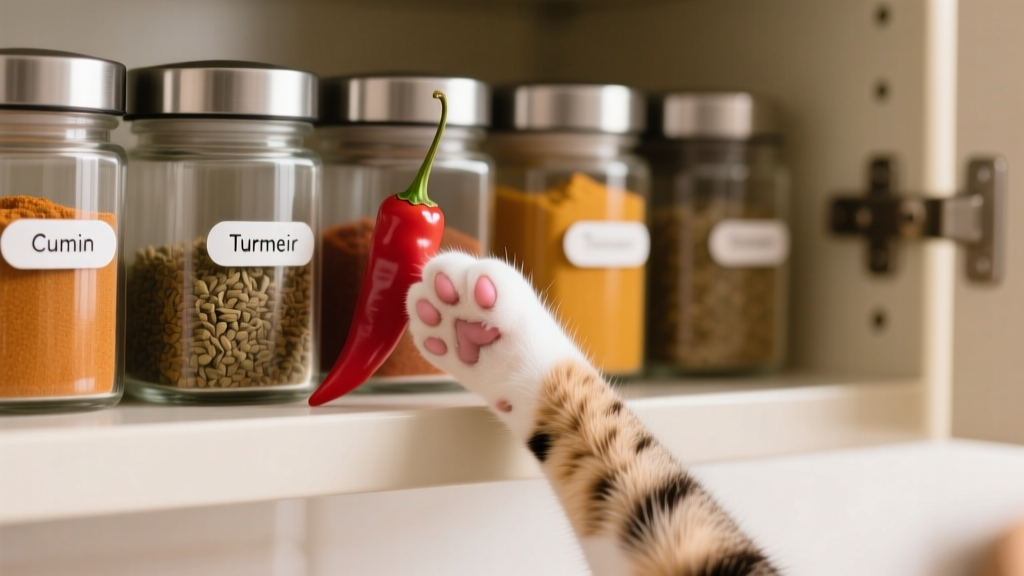
You’re cooking dinner, you turn your back for three seconds, and there it is: a little furry arm snaking into the spice rack like a tiny burglar with whiskers. Maybe your cat hooks a paw around a jar of oregano and tries to drag it out. Maybe they tap the cinnamon like it owes them money. Or maybe they do the classic move—stare intensely at the rack, then slowly reach in as if the laws of physics are optional.
If you’ve ever wondered why your cat is so fascinated by the spice rack (of all things), you’re not alone. This behavior is one part curiosity, one part “I’m practicing my hunting skills,” and one part “I enjoy making you watch me do something mildly chaotic.” The good news: in most cases it’s completely normal—and it can tell you a lot about your cat’s mind and mood.
Why Cats Do This: The Science (and Evolution) Behind the Paw
Cats are natural problem-solvers and opportunistic hunters. In the wild, a cat’s paw is a multipurpose tool: it bats, hooks, scoops, tests, and manipulates. That reaching motion you see at the spice rack is a close cousin of how cats investigate a mouse hole, fish for prey under leaves, or pull something interesting out of a tight space.
Here are the big drivers behind “spice rack pawing”:
- Predatory sequence practice: Even well-fed indoor cats retain the instinct to stalk, paw, and capture. Reaching into a shelf mimics “something is hiding in there.”
- Curiosity + novelty: Spices are packed with intense smells. Your cat’s nose is far more sensitive than yours, and a rack full of jars is basically a museum of scents.
- Enrichment seeking: Indoor environments can be predictable. A spice rack is interactive: objects clink, wobble, roll, and sometimes fall (very satisfying, from a cat’s perspective).
- Foraging-style behavior: Cats are wired to “work” a little for interesting outcomes. Reaching in is a form of exploration that can be self-rewarding.
- Attention and social learning: If you react—laughing, talking, rushing over—your cat may learn that the spice rack reliably produces human engagement.
It’s also worth noting that cats explore with their paws more than many people expect. Whiskers help measure spaces, but paws gather detailed information: texture, weight, movement, even temperature. A jar that shifts when tapped gives instant feedback: “Oh! That’s a thing. I can affect it.” Cats love that.
A Detailed Breakdown: Different Spice Rack Scenarios (and What’s Going On)
Not all spice rack investigations are the same. The context tells you what your cat is seeking.
1) The “Slow-Motion Hook”
Your cat reaches in with extreme deliberation, claws half-sheathed, eyes wide. This is classic investigative play. They’re testing: “Does it move? Does it fall? Is it safe?” Cats often go slow when something is novel, noisy, or slightly uncertain.
2) The “Tap-Tap-Tap”
Rapid taps on jars or a swat that makes lids rattle usually means the behavior has become a game. The sound is stimulating, the movement is fun, and the rack becomes a DIY toy.
3) The “Full Extraction Attempt”
If your cat hooks a jar and tries to drag it out, you’re seeing problem-solving plus persistence. This can happen more with smart, high-energy cats or cats who are under-enriched. It’s not “naughty,” it’s “I found a puzzle.”
4) The “Sniff, Flehmen, Paw” Combo
Some cats sniff spices, then make a funny face—open mouth, curled lip (the flehmen response). They’re processing scent molecules using the vomeronasal organ (Jacobson’s organ). Spices can be intense, and your cat might be sampling them like an amateur perfumer.
5) The “Only When You Cook” Pattern
If your cat only targets the rack during meal prep, it may be about social curiosity (“What are you doing?”), routines, and scent association. Cooking smells can raise arousal levels and draw cats into the kitchen like a magnet.
What This Behavior Says About Your Cat’s Mood
Spice rack pawing is surprisingly informative. Look at the whole body, not just the paw.
- Relaxed curiosity: Tail neutral or gently swishing, ears forward, loose posture, slow blinks between investigations. Your cat is simply entertained and engaged.
- Playful arousal: Quick movements, “butt wiggle,” focused stare, dilated pupils, bouncing between objects. Your cat is in hunting/play mode.
- Frustration or boredom: Repeated attempts, escalating intensity, knocking items down, then looking around as if seeking more stimulation. This can be a sign your cat needs more structured play or environmental enrichment.
- Stress or displacement: If the pawing happens after a loud noise, visitor, or conflict with another pet, it may be a displacement behavior—something to do with the paws when the emotions are bigger than the moment.
- Attention-seeking: Your cat looks at you, paws the rack, looks back at you—especially if you’ve reacted strongly in the past. Cats are excellent at repeating what works.
In most cases, the mood behind it is healthy: engaged, curious, mentally active. That’s a good thing. The goal is simply to channel it safely.
Related Quirky Behaviors You Might Notice
Spice rack pawing often travels with a few familiar “cat classics”:
- Fishing in tight spaces: Reaching under the fridge, couch, or door gap for invisible treasures.
- Counter surfing with a mission: Not always for food—sometimes for exploration, height, and better vantage points.
- Knocking items off shelves: A quick physics experiment, often reinforced by your reaction or the thrill of movement.
- Obsessing over crinkly packaging: Sensory play—sound and texture are irresistible to many cats.
- Investigating strong-smelling items: Tea tins, coffee bags, herbal sachets, even your gym shoes (unfortunately).
Normal vs. Concerning: When to Pay Closer Attention
Most spice rack curiosity is normal. It becomes a concern when it’s unsafe, obsessive, or tied to a health issue.
Generally normal
- Occasional pawing/sniffing when in the kitchen
- Playful tapping without signs of distress
- Interest in scents and new objects
Potentially concerning
- Compulsive repetition: Your cat can’t disengage, does it for long periods, or seems agitated if interrupted.
- Ingestion attempts: Licking/eating spices, chewing lids, or trying to bite jars open.
- Sudden intense behavior change: A formerly calm cat becomes relentlessly fixated on cupboards and food areas.
- Other symptoms present: Increased thirst/urination, weight loss, vomiting, restlessness, vocalizing at night—these can indicate medical issues (thyroid disease, gastrointestinal discomfort, cognitive changes in seniors, etc.).
- Safety risks: Heavy glass jars overhead, unstable racks, essential oils nearby, or powders that could irritate eyes/nose.
If you see concerning signs, a vet check is wise—especially if the behavior is new and intense. If it’s more about escalating mischief and boredom, a behavior and enrichment plan usually helps quickly.
How to Respond (Without Turning It Into a Forbidden-Fruit Game)
The trick is to keep your cat safe while respecting the need to explore. Think: “redirect, don’t punish.” Punishment can increase stress, make the behavior sneakier, and accidentally reward it with attention.
1) Make the spice rack boring and safe
- Move spices to a closed cabinet or a latched pantry.
- Use non-breakable containers where possible.
- Stabilize freestanding racks so they can’t topple.
2) Provide an approved “paw playground” nearby
- A puzzle feeder or treat ball in the kitchen during cooking time
- A cardboard box with crumpled paper and a few safe toys
- A “foraging tray” (shallow bin with ping-pong balls or large craft pom-poms your cat can’t swallow)
3) Redirect with purpose
If your cat reaches into the rack, calmly guide them to an alternative activity: toss a toy, start a short wand toy session, or cue them to a perch. Cats respond better when you give them a yes, not just a no.
4) Build a daily play routine
Two to three short play sessions (5–10 minutes each) can dramatically reduce “I need to invent my own entertainment” behaviors. End with a small snack to mimic the hunt-catch-eat sequence.
5) Reinforce calm choices
If your cat sits on a kitchen mat or perch while you cook, quietly reward that with a treat or gentle praise. You’re teaching: “This spot pays.”
Fun Facts and Research-Style Nuggets
- Cats often prefer “interactive” objects: Items that move, make noise, or respond to touch are especially rewarding—spice jars check all three boxes.
- Your cat’s paw is a sensory tool: Cats have sensitive paw pads that help them detect texture and vibration. A rattling rack provides rich feedback.
- Some plant compounds can be extra intriguing: Just as catnip affects some cats, other aromatic plants can spark interest—though not always in the same “blissed-out” way.
- The flehmen response isn’t a “bad smell” face: It’s a way of analyzing scent signals more deeply, like switching from “sniffing” to “reading the fine print.”
FAQ: Cat Pawing at the Spice Rack
1) Is my cat trying to tell me they’re hungry?
Sometimes, especially if it happens around meal prep or if your spices are near food. But more often it’s curiosity and play. If your cat is begging persistently, check meal timing, portioning, and whether they’d benefit from puzzle feeding.
2) Are spices dangerous for cats?
Some can be irritating or harmful if ingested (and powdered spices can irritate eyes/noses). The bigger risk is usually the container—glass breaking, choking hazards from lids, or exposure to concentrated essential oils stored nearby. Keep spices secured and discourage licking/chewing.
3) Why does my cat only do this when I’m watching?
Cats are excellent at learning what gets a reaction. If pawing the rack makes you talk, rush over, or pick them up, it can become a reliable attention button. Try calmly redirecting and rewarding an alternative behavior (like sitting on a mat).
4) My cat knocked spices over once and now seems obsessed—why?
Because it worked. The crash, the rolling jar, and your sudden attention can be intensely rewarding. The solution is to prevent access (closed storage) and provide a better “toy” that meets the same needs: movement, sound, and problem-solving.
5) Could this mean my cat is anxious?
It can, but it doesn’t automatically. Look for other stress signs: hiding more, overgrooming, changes in appetite, litter box issues, startled behavior, tension with other pets. If spice rack pawing appears after stressors, add calming routines and safe spaces—and consider a vet/behavior consult if it escalates.
6) Should I ever let my cat play with spice jars?
I wouldn’t recommend it. It’s too easy for a jar to break, for a lid to come off, or for your cat to inhale/ingest something irritating. Instead, offer sturdy, cat-safe alternatives: treat puzzles, kicker toys, or a “batting toy” that can’t shatter.
That little paw reaching into the spice rack is your cat’s brain at work—testing, learning, and turning your kitchen into a mini safari. With a few safety tweaks and some strategic enrichment, you can keep the curiosity (and the charm) while protecting both your cat and your oregano.
Has your cat ever chosen one specific spice jar as their personal nemesis—or do they prefer the whole rack like a buffet of chaos? Share your cat’s funniest kitchen curiosity stories with us on catloversbase.com—we’d love to feature reader tales and tips.