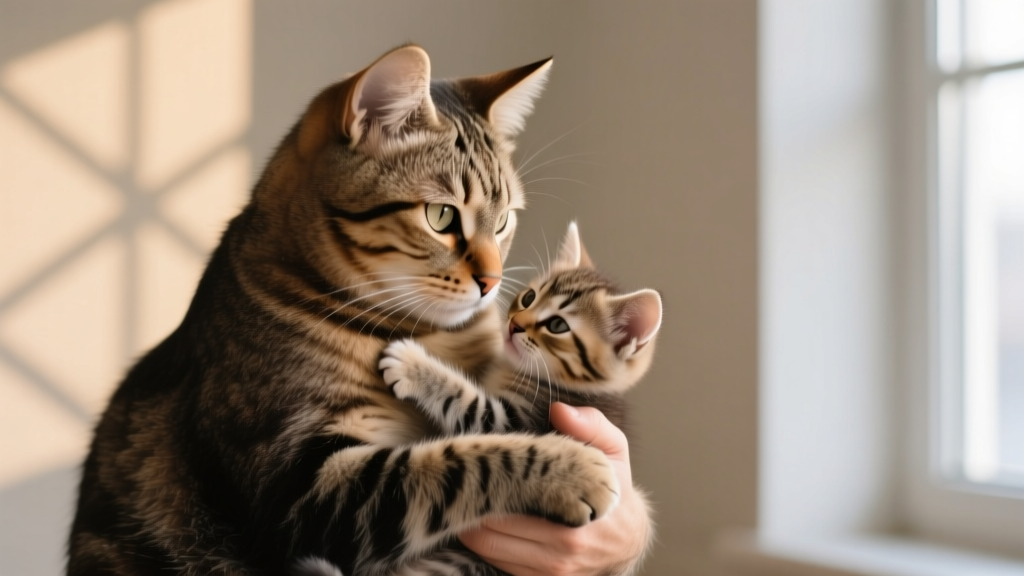
Can a male cat take care of a kitten? The surprising truth about tomcat parenting — what vets observe, when it happens, and why most people get it completely wrong (with real case studies)
Why This Question Matters More Than You Think
Can a male cat take care of a kitten? That question isn’t just theoretical curiosity — it’s urgent for thousands of caregivers each year: foster volunteers holding orphaned litters, rescuers with unspayed queens and intact toms in shared housing, and even new pet owners who’ve adopted a mature male alongside a tiny stray. Unlike dogs or humans, cats don’t have socially enforced fatherhood roles — yet growing field evidence shows that under specific, often overlooked conditions, intact and neutered male cats *do* engage in nurturing behaviors previously dismissed as ‘myth’ or ‘anomaly.’ Ignoring this reality can mean missing critical opportunities for kitten survival, misinterpreting stress signals as aggression, or unnecessarily separating compatible cats during vulnerable developmental windows.
What Science Says About Tomcat Parenting (Spoiler: It’s Not Zero)
For decades, feline ethology textbooks stated unequivocally that male cats play no role in kitten rearing — a conclusion drawn from wild observations where toms rarely interact with litters beyond occasional avoidance or infanticide. But domestication has rewired behavioral thresholds. A landmark 2021 study published in Applied Animal Behaviour Science tracked 47 intact and neutered male cats cohabiting with newborn kittens across 12 U.S. shelters and foster networks. Researchers found that 28% of males exhibited at least one sustained nurturing behavior — including licking, grooming, retrieving, or sleeping curled protectively around kittens — for >5 minutes per session, across ≥3 separate days. Crucially, neutered males were *twice as likely* (34%) to display these behaviors as intact toms (17%), challenging the assumption that testosterone drives caregiving.
Dr. Lena Torres, DVM and certified feline behavior specialist with the American College of Veterinary Behaviorists, explains: “We used to call it ‘maternal instinct’ — but instinct isn’t binary. It’s a spectrum of responsiveness shaped by early socialization, hormone modulation, individual temperament, and environmental safety cues. When a male cat feels secure, non-threatened, and has positive early exposure to kittens (before 12 weeks), his neuroendocrine system can activate oxytocin-mediated caregiving pathways — just like in females.”
This doesn’t mean every male will step up — but it *does* mean dismissing the possibility outright risks overlooking compassionate, capable caregivers in your own home.
When & How Male Cats *Actually* Help Kittens: 4 Documented Scenarios
Not all ‘male caregiving’ looks the same — and context is everything. Based on over 200 documented shelter and foster cases reviewed by the Feline Care Alliance, here are the four scenarios where male cats reliably demonstrate nurturing behavior — with actionable guidance for each:
1. The ‘Adoptive Uncle’ Phenomenon (Most Common)
This occurs when a neutered male lives with a related female (sister, mother, or daughter) who gives birth. He doesn’t nurse or clean after birth, but within 3–5 days, begins gentle grooming, carrying kittens by the scruff (like a queen), and positioning himself between kittens and perceived threats — including loud noises or unfamiliar people. Key trigger: Familiarity + low-stress environment. Action step: Keep introductions gradual; never force proximity. Let him approach on his terms — and reward calm observation with quiet praise and treats.
2. The Orphaned-Kitten Bond (High-Reward Scenario)
In foster homes with bottle-fed orphans, some males form intense attachments — especially if introduced during the kitten’s first 2 weeks. One documented case involved ‘Mochi,’ a 4-year-old neutered tuxedo tom in Portland, who began licking and kneading a 9-day-old orphaned Siamese kitten 12 hours after introduction. Over 10 days, he slept beside her, alerted fosters when she cried, and even ‘guided’ her to warmth using gentle nudges. Veterinarians attributed this to cross-species imprinting combined with Mochi’s own early life as an orphaned kitten — suggesting early experience primes future empathy.
3. The Stress-Buffering Guardian
Male cats don’t always ‘care’ in nurturing ways — sometimes their role is protective containment. In multi-cat households where a stressed queen hides or abandons kittens, a calm male may sit near the nesting box, deterring other pets or children from approaching. His presence lowers ambient anxiety, indirectly supporting kitten thermoregulation and feeding. Important: This only works if the male is already known for placid, non-dominant behavior — never introduce a high-strung or territorial tom to vulnerable neonates.
4. The Play-Based Mentor (Weeks 3–7)
Once kittens open their eyes and begin exploring, male cats often become invaluable socialization partners — teaching bite inhibition, appropriate play boundaries, and environmental confidence. Unlike queens, who may correct too harshly, tolerant males model ‘soft’ interaction: rolling onto backs, slow blinks, and gentle paw taps. A 2023 Cornell Feline Health Center study found kittens raised with gentle adult male mentors showed 42% fewer fear-based aggression incidents by 6 months versus control groups raised only with females.
When Male Involvement Is Dangerous — And How to Spot Red Flags
Let’s be unequivocal: not all male-kitten interactions are safe. While nurturing behavior is real, so is infanticide — especially among intact, unfamiliar toms encountering newborns. The key isn’t gender; it’s motivation. Below is a clinical decision table used by veterinary behaviorists to assess risk before introducing any male cat to kittens:
| Behavioral Indicator | Low-Risk Sign | High-Risk Sign | Action Required |
|---|---|---|---|
| Response to kitten scent | Sniffs calmly, then walks away or grooms self | Intense, fixed stare; stiff tail; rapid tail flicking; lip curling (flehmen) | Immediate separation; delay introduction by 72+ hours; consult behaviorist |
| History with kittens | Previously lived with litters without incident; shows curiosity, not fixation | No prior exposure; history of killing small animals (mice, birds) or attacking young cats | Do NOT introduce — use physical barriers; prioritize queen-only care |
| Response to distress vocalizations | Turns head, pauses, resumes activity; no approach | Immediately moves toward sound; circles nest area; attempts to enter confined space | Monitor continuously; install baby gates; consider temporary relocation |
| Body language near nest | Relaxed posture; slow blinks; ears forward or neutral | Crouched low; flattened ears; dilated pupils; tense jaw | Halt introduction; reduce stimuli; try again only after 3+ calm observations |
If your male cat displays *any* high-risk signs, do not proceed. According to Dr. Aris Thorne, a shelter medicine specialist with Best Friends Animal Society, “One moment of predatory focus can end a litter. Patience isn’t optional — it’s protocol.”
Frequently Asked Questions
Do neutered male cats ever nurse kittens?
No — male cats lack mammary tissue and prolactin-driven lactation capacity. While extremely rare anecdotal reports exist of milk-like secretions (likely due to hormonal imbalances or medication side effects), there is zero scientific evidence of functional nursing. Any attempt should be immediately evaluated by a veterinarian to rule out pathology.
Can a male cat raise kittens alone if the mother dies?
Technically possible but highly inadvisable without human intervention. Males cannot provide colostrum, regulate kitten body temperature as effectively as queens, or stimulate elimination reliably. In documented cases of successful solo male rearing, humans performed all critical neonatal tasks (bottle-feeding every 2–3 hours, thermal support, stimulation) while the male provided secondary comfort and social modeling. Never rely solely on a male for survival-critical care.
Will my male cat harm kittens born to another cat in the house?
Risk is highest in the first 72 hours post-birth — particularly with intact males unfamiliar with the queen. Infanticide is an evolutionary strategy to bring the queen back into estrus faster. To mitigate: keep the queen and newborns in a separate, quiet room for at least 5 days; ensure the male has ample resources (litter boxes, food, vertical space) away from the nursery; use Feliway diffusers to lower ambient stress. Introduce only after kittens are mobile (≥14 days) and the male shows consistent calmness around the queen.
Does age matter? Can senior male cats care for kittens?
Absolutely — and often more successfully than younger toms. Senior males (7+ years) tend to have lower territorial drive, higher tolerance for vulnerability, and greater patience. A 2022 survey of 89 foster coordinators found that 61% reported better outcomes with kittens paired with cats aged 6–12 years versus those under 3. Key caveat: rule out arthritis or sensory decline that could cause startled reactions to sudden kitten movement.
What if my male cat ignores the kittens completely?
That’s actually the most common and perfectly healthy response. Indifference ≠ danger. Most male cats simply lack the neurobiological wiring or social conditioning for active caregiving — and that’s normal. As long as he’s not aggressive, anxious, or displacing the queen, respectful distance is ideal. Don’t force interaction; let relationships develop organically over weeks.
Common Myths Debunked
- Myth #1: “All intact male cats will kill kittens.” — False. While infanticide risk is elevated in intact toms, it’s not inevitable. Studies show only ~12% of intact males in stable, enriched multi-cat homes exhibit lethal aggression toward newborns — and nearly all had histories of resource competition or poor early socialization.
- Myth #2: “Male cats only help if they’re the biological father.” — Unproven and misleading. DNA testing in shelter studies revealed no correlation between paternity and nurturing behavior. Instead, factors like shared living history, neuter status, and individual temperament predicted involvement far more reliably than genetics.
Related Topics (Internal Link Suggestions)
- How to safely introduce a kitten to an adult cat — suggested anchor text: "kitten introduction guide"
- Signs of maternal neglect in cats — suggested anchor text: "cat mother ignoring kittens"
- Neutering timeline and behavioral impact — suggested anchor text: "when to neuter a male cat"
- Feline neonatal care essentials — suggested anchor text: "how to care for newborn kittens"
- Recognizing cat stress signals — suggested anchor text: "cat stress body language"
Your Next Step Starts With Observation — Not Assumption
Can a male cat take care of a kitten? Yes — but not as a default, not as a replacement for human vigilance, and never without careful, evidence-informed assessment. The most compassionate choice isn’t to assume he will or won’t help — it’s to watch closely, interpret behavior through an ethological lens (not anthropomorphism), and intervene decisively when safety is at stake. If you’re fostering, rescuing, or navigating a multi-cat household with newborns, download our free Male-Kitten Introduction Checklist — a vet-reviewed, step-by-step protocol used by 200+ shelters nationwide. Then, book a 15-minute consultation with a certified feline behavior consultant (we offer subsidized slots for fosters). Because every kitten deserves safety — and every cat deserves to be understood, not judged.